What did the ancient Romans actually eat? The answer is more surprising than you might expect. Long before tomatoes became essential to Italian cooking, Roman kitchens combined meat, fruit, honey, wine, aromatic herbs, and fermented fish sauce in recipes that might seem unusual today. One of our most valuable sources for understanding these flavors is De re coquinaria, the ancient Roman cookbook traditionally attributed to Marcus Gavius Apicius. This extraordinary collection offers a fascinating glimpse into Roman culinary traditions, revealing how food reflected wealth, social status, cultural exchange, and the sophisticated tastes of the ancient Mediterranean world.
Exploring the food of ancient Rome becomes even more fascinating when combined with visits to the places where Roman history unfolded. Travelers interested in connecting archaeology with Italy’s living culinary traditions can discover day trips from Rome with Kirba Tours. These experiences include historic destinations such as Hadrian’s Villa in Tivoli and Ostia Antica, alongside visits to family-run wineries, olive mills, and artisan producers in the Lazio countryside. From traditional olive oil production to local wines, cheese, and honey, these excursions offer a rewarding way to explore the ingredients, landscapes, and cultural traditions that have shaped Italian food across the centuries.
But what exactly is De re coquinaria? Who was Apicius, and how closely does the surviving cookbook reflect what Romans ate two thousand years ago? To understand its importance, we need to look at the book’s complicated history, its ten sections, its unusual ingredients, and one particularly revealing recipe that combines pork, fruit, honey, and fish sauce.
What Is De Re Coquinaria?
De re coquinaria, generally translated as “On the Subject of Cooking” or “On Cookery,” is a Latin collection of recipes associated with the culinary traditions of ancient Rome.
It is among the most important surviving sources for the study of Roman gastronomy and ancient Mediterranean food culture.
Rather than presenting dishes in the format of a modern cookbook, the text provides relatively concise preparation instructions. Recipes often identify ingredients, describe how they should be combined, and explain the cooking process without specifying exact quantities or cooking times.
The collection includes preparations involving vegetables, legumes, grains, fish, shellfish, poultry, pork, lamb, game, sauces, and elaborate seasonings.
Some dishes contain ingredients that remain familiar in Mediterranean cuisine, including:
- Olive oil
- Wine and wine reductions
- Honey
- Vinegar
- Fresh and dried herbs
- Legumes and vegetables
- Fish and seafood
- Meat and poultry
Other ingredients, particularly fermented fish sauces and certain imported spices, reveal a culinary world with flavor combinations quite different from those commonly associated with Italian food today.
However, the book should not be considered a complete record of what every Roman citizen ate. Many of its more elaborate recipes reflect sophisticated cooking practices and ingredients associated with affluent households.
Who Was Marcus Gavius Apicius?
The name Apicius is closely associated with luxurious dining in ancient Rome.
Marcus Gavius Apicius was a famous Roman gourmet who lived during the first century AD, around the reign of Emperor Tiberius. Ancient writers remembered him for his enthusiasm for expensive ingredients and extravagant culinary experiences.
Over time, his name became almost synonymous with refined cooking and gastronomic excess.
That reputation explains why the famous recipe collection was traditionally attributed to him.
Did Apicius Actually Write De Re Coquinaria?
Although the cookbook carries Apicius’s name, modern scholars generally agree that the surviving text was not written in its entirety by the first-century gourmet.
The language, organization, and historical layers of the collection suggest a much later compilation, probably dating to the late fourth or early fifth century AD.
Some recipes may preserve earlier Roman culinary traditions, potentially including material associated with Apicius himself. Others appear to have been added, revised, or reorganized over several centuries.
In other words, De re coquinaria is best understood as a collection of culinary knowledge transmitted and adapted across generations, rather than a single cookbook written by one identifiable author.
This layered history makes the text especially valuable. It preserves not just individual recipes but also traces of how Roman cooking developed from the early imperial period into Late Antiquity.
How Is De Re Coquinaria Organized? The Ten Books of Apicius
The surviving collection is traditionally divided into ten books with Greek-derived titles, each devoted to particular ingredients, preparations, or culinary techniques.
This organization reveals the practical ambitions of the text: it was intended as a reference for preparing different categories of food.
The Ten Books of De Re Coquinaria
- Book I – Epimeles: Culinary preparation, preservation techniques, flavored wines, sauces, and seasonings.
- Book II – Sarcoptes: Minced meat, sausages, forcemeats, and related preparations.
- Book III – Cepuros: Vegetables and methods of preparing garden produce.
- Book IV – Pandecter: Mixed dishes, preparations served in bowls or dishes, and elaborate combinations of ingredients.
- Book V – Ospreon: Legumes, including beans, peas, and lentils.
- Book VI – Aeropetes: Poultry and other birds.
- Book VII – Polyteles: More luxurious preparations, including eggs, mushrooms, meats, and specialty dishes.
- Book VIII – Tetrapus: Four-legged animals, including domestic livestock and game.
- Book IX – Thalassa: Fish and seafood preparations.
- Book X – Halieus: Fish dishes and the sauces used to prepare them.
The presence of Greek titles reflects the wider influence of Greek culinary and intellectual traditions on Roman culture.
Throughout its history, Rome absorbed ingredients, techniques, and dining customs from territories across the Mediterranean.
The cookbook reflects this interconnected culinary environment, combining familiar local products with seasonings and preparations associated with a wider world of trade and cultural exchange.
What Did Ancient Roman Food Taste Like?
One of the most fascinating aspects of De re coquinaria is its approach to flavor.
Modern diners often separate sweet foods from savory dishes. Ancient Roman recipes, particularly those preserved in this collection, frequently brought these flavors together.
Honey could appear in meat sauces. Fruit might accompany pork or game. Vinegar added acidity, while fish sauce introduced saltiness and depth.
Rather than relying on one dominant flavor, many recipes combined several contrasting ingredients.
Garum and Liquamen: Roman Fish Sauces
Among the most characteristic seasonings of ancient Roman cuisine were fermented fish sauces, commonly associated with the terms garum and liquamen.
These sauces were produced from fish and salt through processes that developed intensely savory liquids used to season food.
Although modern descriptions often treat garum and liquamen as interchangeable, historical evidence suggests that the terms could refer to different products or preparations depending on the period.
In the surviving text of Apicius, liquamen is especially prominent as a cooking ingredient.
Its role was comparable in some ways to the use of fish sauce in certain modern Southeast Asian cuisines: a relatively small quantity could contribute substantial saltiness and savory depth to a dish.
Roman cooks used these sauces in meat preparations, vegetables, seafood dishes, and complex dressings.
Honey, Wine, and Vinegar
Another distinctive characteristic of ancient Roman cooking was the frequent combination of sweetness and acidity.
Honey was a widely used sweetener, while wine and vinegar contributed different levels of sweetness, acidity, and aroma.
The cookbook also refers to passum, a sweet wine made from dried or partially dried grapes, and various concentrated grape preparations.
These ingredients could be incorporated into sauces for meat, poultry, vegetables, or fruit.
The result was a style of cooking in which sweet, sour, salty, and aromatic elements worked together within the same dish.
Spices, Herbs, and the Mystery of Silphium
Ancient Roman recipes made extensive use of herbs and spices, including pepper, cumin, coriander, dill, mint, lovage, and other aromatic plants.
One particularly intriguing ingredient was silphium, also associated with the Latin term laser.
The highly prized silphium historically associated with Cyrenaica in North Africa became scarce in antiquity and is generally considered to have disappeared.
However, references to related seasonings in later Roman recipes require careful interpretation because substitute plants, including types of asafoetida, were also used.
The presence of these ingredients illustrates the complexity of ancient Roman trade networks and the importance placed on distinctive flavors.
Minutal ex Praecoquis: Pork, Apricots, and Honey in One Roman Dish
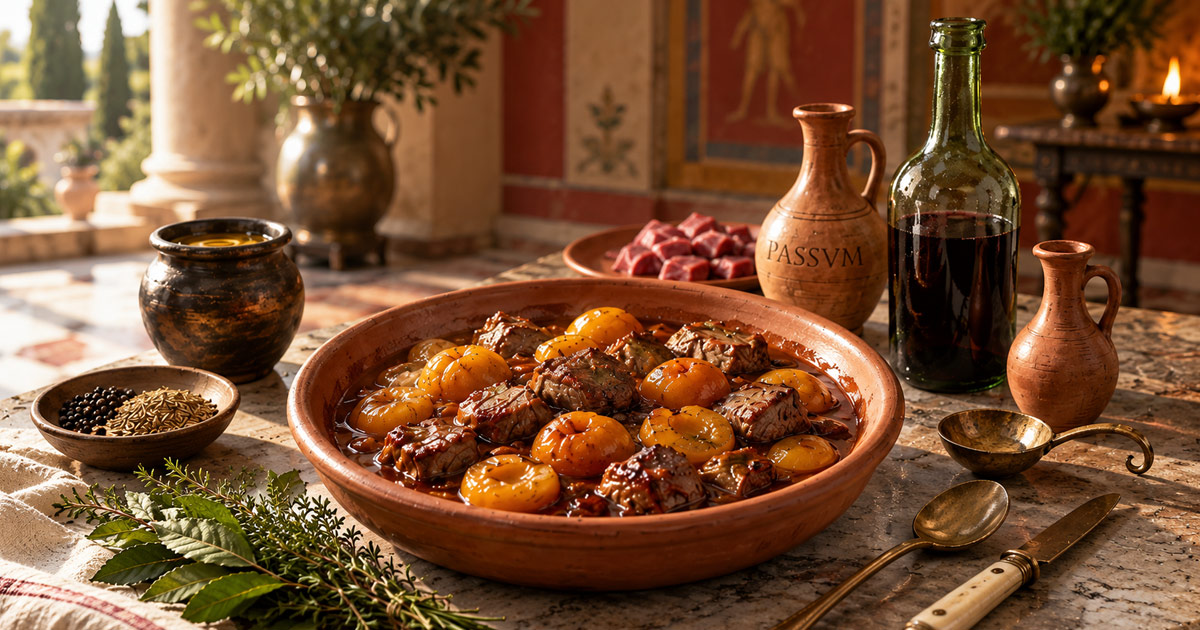
Perhaps one of the most revealing examples of the culinary imagination preserved in De re coquinaria is a preparation known as Minutal ex praecoquis.
Found in Book IV, this dish combines cooked pork with fruit, honey, wine, fish sauce, herbs, and spices.
For modern readers, the combination might sound unexpected. Yet it demonstrates how Roman cooks could build complex flavors by blending ingredients that contemporary diners might associate with different courses.
What Is Minutal ex Praecoquis?
A minutal was a preparation involving small pieces of ingredients cooked together in a seasoned sauce.
In Minutal ex praecoquis, the principal ingredients include diced cooked pork shoulder and fruit traditionally identified as apricots.
The Latin term praecoqua is generally associated with apricots or closely related early-ripening fruits, although identifying ancient botanical varieties with complete certainty can be difficult.
The recipe calls for an unusual combination of ingredients:
- Cooked pork shoulder
- Olive oil
- Liquamen, or Roman fish sauce
- Wine
- Shallots or small onions
- Black pepper
- Cumin
- Dried mint
- Dill
- Honey
- Passum, or sweet raisin wine
- A small amount of vinegar
- Pitted apricots
- Tracta, a wheat-based preparation used to thicken the sauce
The ingredients create a rich combination of sweetness, acidity, saltiness, and aromatic spice.
How the Ancient Roman Recipe Was Prepared
According to the instructions preserved in Book IV, the cook begins by placing olive oil, liquamen, and wine into a cooking vessel.
Finely chopped shallots and small pieces of previously cooked pork shoulder are added.
Separately, pepper, cumin, dried mint, and dill are ground together. Honey, additional liquamen, passum, vinegar, and some of the cooking juices are then combined with the spices.
Once the ingredients are brought together, pitted fruit is added and allowed to cook.
Finally, pieces of tracta are incorporated to thicken the preparation, which is finished with a sprinkling of pepper.
The finished dish would have offered a remarkable balance between savory pork, sweet fruit, acidic wine and vinegar, and intensely seasoned sauce.
How to Recreate an Ancient Roman Pork and Apricot Dish Today
For food enthusiasts who want to experiment with Roman culinary history, Minutal ex praecoquis offers a particularly approachable starting point.
Some ancient ingredients are difficult to obtain, and the original recipe does not provide the precise measurements expected in a modern cookbook.
The following version is therefore a modern adaptation inspired by Apicius, not an exact historical reconstruction.
Ingredients for a Modern Adaptation
- 1 pound of cooked pork shoulder, cut into small cubes
- 6–8 fresh apricots, pitted and sliced
- 2 tablespoons olive oil
- 1 small shallot, finely chopped
- 1/2 cup dry white wine
- 1/4 cup sweet dessert wine
- 1 tablespoon fish sauce
- 1 tablespoon honey
- 1 teaspoon red wine vinegar
- 1/2 teaspoon ground cumin
- 1/4 teaspoon freshly ground black pepper, plus more to finish
- A pinch of dried mint
- A pinch of dried dill
- A little water or unsalted broth, if needed
- Optional: a small amount of plain breadcrumbs for thickening
Preparation
- Prepare the aromatics. Warm the olive oil in a saucepan and gently cook the chopped shallot until softened.
- Add the pork. Stir in the previously cooked pork shoulder and pour in the dry white wine.
- Make the sauce. Add the fish sauce, honey, sweet wine, vinegar, cumin, pepper, mint, and dill. Stir gently to combine.
- Add the fruit. Place the sliced apricots into the pan and simmer over low heat until they soften and the sauce develops its flavor.
- Adjust the consistency. Add a little water or broth if necessary. For a thicker sauce, incorporate a small amount of plain breadcrumbs.
- Finish and serve. Taste the sauce, adjust the seasoning carefully, and finish with a little freshly ground pepper.
This adaptation offers a modern interpretation of the sweet-and-savory combinations found in the ancient text.
Modern fish sauce stands in for liquamen, while sweet dessert wine provides an accessible alternative to ancient passum. Breadcrumbs are a practical modern thickener rather than an exact substitute for Roman tracta.
What matters most is experiencing the flavor contrast that made the original recipe so distinctive.
Did All Ancient Romans Eat Like Apicius?
Although De re coquinaria is invaluable for understanding Roman cooking, it is important to distinguish the elaborate cuisine represented by the text from the everyday diet of the wider population.
Many ordinary Romans relied on more accessible foods, including grains, bread, legumes, vegetables, olives, and other products available according to region, season, and economic circumstances.
Wealthier households could obtain a much greater variety of ingredients, including imported spices, luxurious seafood, and unusual meats.
The cookbook includes preparations involving animals such as flamingos and other birds that would have been far removed from the daily diet of most people.
These elaborate dishes help illustrate the relationship between cuisine, wealth, social status, and hospitality in Roman society.
Studying Apicius therefore requires two perspectives: the book documents real culinary traditions, but it also preserves a particular vision of sophisticated cooking rather than a complete portrait of Roman food consumption.
The Manuscripts of De Re Coquinaria: How the Recipes Survived
One of the most remarkable aspects of De re coquinaria is its survival through the centuries.
The original ancient compilation has not survived in the form in which it was first assembled. Instead, modern knowledge of the text depends largely on manuscripts copied during the Middle Ages.
Two particularly important witnesses date to the ninth century.
The New York Academy of Medicine Manuscript
One of the most significant surviving manuscripts is preserved at the New York Academy of Medicine.
The manuscript, associated with the monastery of Fulda in Germany, was produced in the ninth century and eventually entered the Academy’s collection in the twentieth century.
It provides an invaluable witness to the transmission of ancient Roman culinary knowledge through medieval European scholarly culture.
The Vatican Manuscript
Another important ninth-century manuscript is preserved in the Vatican Apostolic Library under the shelfmark Urb. lat. 1146.
Together, these medieval witnesses form the foundation for scholarly editions of the surviving recipe collection.
The existence of different manuscript traditions also reminds us that ancient texts were copied, transmitted, and sometimes altered over time.
The Excerpts of Vinidarius
A separate but related text is known as the Apici excerpta a Vinidario, or the Excerpts from Apicius compiled by Vinidarius.
This shorter collection survives through a different manuscript tradition and contains recipes and culinary material associated with the name of Apicius.
Its relationship with De re coquinaria is important for understanding how culinary texts circulated and developed in Late Antiquity and the early medieval period.
Rather than representing a simple continuation of one author’s work, these texts reveal a broader history of collecting and preserving culinary knowledge.
What De Re Coquinaria Tells Us About Roman Food Culture
Beyond its recipes, De re coquinaria reveals several important characteristics of Roman food culture.
Food Was Connected to Trade
The presence of imported spices, specialized sauces, and ingredients from different regions shows how Roman cooking benefited from commercial networks across the Mediterranean and beyond.
Cooking Required Specialized Knowledge
Recipes involving elaborate sauces, complex seasoning, and multiple preparation stages suggest the importance of experienced cooks, particularly in wealthy households.
Flavor Preferences Were Different from Modern Expectations
The frequent combination of honey, vinegar, wine, fruit, and fish sauce demonstrates that culinary categories have changed considerably over time.
Roman Cuisine Was Not Modern Italian Cuisine
Many ingredients familiar in Italy today became common long after the Roman Empire.
Tomatoes, for example, arrived in Europe from the Americas many centuries later, making them absent from ancient Roman cooking.
Reading Apicius helps separate historical Roman food traditions from the dishes associated with contemporary Italian cuisine.
Frequently Asked Questions About De Re Coquinaria
What does De re coquinaria mean?
De re coquinaria is a Latin title generally translated as “On Cookery” or “On the Subject of Cooking.” It refers to a collection of recipes associated with ancient Roman cuisine.
Who wrote De re coquinaria?
The cookbook is traditionally attributed to Marcus Gavius Apicius, a famous first-century Roman gourmet. However, the surviving collection was compiled much later and probably incorporates material from multiple periods and sources.
When was De re coquinaria written?
Although some recipes may preserve earlier culinary traditions, scholars generally date the surviving compilation to approximately the late fourth or early fifth century AD.
How many books are in De re coquinaria?
The collection is organized into ten books, each devoted to different cooking techniques, ingredients, or categories of food.
What is the most characteristic ingredient in Apicius’s recipes?
One of the most frequently encountered seasonings is liquamen, a Roman fish sauce used to add saltiness and savory depth to various dishes. Honey, wine, vinegar, pepper, and aromatic herbs are also prominent.
What is Minutal ex praecoquis?
Minutal ex praecoquis is a Roman recipe preserved in Book IV of De re coquinaria. It combines cooked pork shoulder with fruit generally identified as apricots, along with honey, wine, fish sauce, herbs, and spices.
Is De re coquinaria an accurate record of ancient Roman food?
It is an important historical source, but it does not represent the entire Roman population’s daily diet. Many recipes reflect more sophisticated preparations and ingredients associated with affluent households, and the surviving text contains material from different historical periods.
Where can you read De re coquinaria today?
The text is available through scholarly editions, historical translations, and digital collections. Readers interested in the original Latin and an early English translation can consult Cookery and Dining in Imperial Rome, translated and edited by Joseph Dommers Vehling.
Why De Re Coquinaria Still Matters Today
De re coquinaria is far more than an ancient collection of cooking instructions. It provides a rare connection to the tastes, ingredients, and culinary imagination of the Roman world.
From elaborate sauces and unusual meats to the combination of pork, fruit, honey, and wine, the recipes demonstrate how ancient cooks approached flavor in ways that continue to surprise modern readers.
The book also reveals how food connects with broader historical themes: Mediterranean trade, social differences, agricultural production, cultural exchange, and the transmission of knowledge across centuries.
For travelers fascinated by Rome, understanding ancient cuisine adds another dimension to visiting archaeological sites such as Ostia Antica and Hadrian’s Villa or discovering the agricultural traditions of the surrounding Lazio countryside.
Exploring these places and tasting the products of modern regional food culture does not recreate an imperial Roman banquet, but it offers a meaningful connection between Italy’s ancient past and its continuing culinary traditions.
Whether you’re passionate about Roman history, interested in historical recipes, or planning a food-focused journey through Italy, De re coquinaria offers a fascinating starting point for discovering how the ancient Romans cooked, ate, and thought about food.