Just a few steps from St. Peter’s Square, there is a historic street where Rome reveals a quieter and more intimate side of its character. Borgo Pio is one of the most distinctive streets near the Vatican, combining Renaissance history, traditional Roman architecture and small details that are easy to miss if you are simply passing through the area.
Located in the historic Borgo district, between the Vatican and Castel Sant’Angelo, Borgo Pio offers visitors an opportunity to explore a different side of Rome while remaining close to some of the city’s most famous landmarks.
From its origins under Pope Pius IV to its curious fountains and religious street shrines, this historic street has many stories to tell.
Where Is Borgo Pio in Rome?
Borgo Pio is located in the Borgo district, just outside Vatican City, on the right bank of the River Tiber.
The street connects Via di Porta Castello with Via di Porta Angelica and runs through an area closely associated with the history of the Vatican and the development of Rome as a destination for pilgrims.
Its location makes it an interesting stop for visitors exploring St. Peter’s Basilica, Castel Sant’Angelo and the surrounding streets.
Rather than heading straight between the major monuments, take some time to explore Borgo Pio and notice the historic buildings, small squares and architectural details along the way.
The History of Borgo Pio
Although the area around Borgo Pio has roots dating back to ancient Rome, the street as we know it today was established during the Renaissance.
On December 5, 1565, Pope Pius IV issued a papal bull entitled Erectionis civitatis Piae prope arcem Sancti Angeli, which can be translated as the establishment of the City of Pius near Castel Sant’Angelo.
The project aimed to create an attractive and healthier residential area close to the Vatican. The plans also addressed practical problems, including flooding from the Tiber, by requiring the ground level to be raised and drainage infrastructure to be developed.
Construction began under Pope Pius IV and continued under Pope Gregory XIII, who completed the project and improved the streets.
The name Borgo Pio comes from Pope Pius IV, whose initiative shaped the street’s original layout.
Today, walking along Borgo Pio means following a route that preserves the memory of a major Renaissance urban development project.
Borgo Pio and the Historic Borgo District
To understand Borgo Pio, it helps to look at the history of the wider Borgo district.
In ancient times, the area known as Ager Vaticanus lay outside the traditional boundaries of the city. It included burial grounds, villas and gardens, and later became increasingly important as Christianity developed around the tomb of St. Peter.
During the Middle Ages, the growing importance of St. Peter’s Basilica attracted pilgrims from across Europe. The area developed around their needs, with religious institutions and facilities dedicated to welcoming visitors.
Pope Leo IV ordered the construction of new defensive walls in the 9th century to protect the area around St. Peter’s from attacks. This fortified territory became known as the Civitas Leonina, or Leonine City.
In 1586, Pope Sixtus V officially established Borgo as Rome’s fourteenth district, known in Italian as the Rione XIV.
The district later underwent significant changes. Between 1935 and 1937, much of the historic Spina di Borgo, the dense urban area that once stood between Castel Sant’Angelo and St. Peter’s, was demolished to make way for Via della Conciliazione.
Although this transformation dramatically changed the historic landscape, Borgo Pio remains an important reminder of the area’s earlier appearance.
What to See in Borgo Pio
One of the most interesting aspects of Borgo Pio is that its appeal lies not in a single major monument but in the smaller details scattered throughout the street.
Here are two details worth looking for during your walk.
1. The Madonnella of Borgo Pio
At the corner of Borgo Pio and Vicolo del Campanile, you can find a small religious shrine known as a Madonnella.
This Baroque-style structure contains an 18th-century fresco depicting the Virgin Mary and Child. The image is enclosed within a stucco medallion decorated with angelic faces, clouds and ornamental garlands.
In 1797, Pope Pius VI ordered an inscription to be placed beneath the shrine, granting an indulgence to the faithful who visited it.
The date is particularly interesting because it came shortly after reports of sacred images moving their eyes or weeping in different parts of Rome during the French invasion of the Papal States.
Although this particular shrine is not officially included among Rome’s recognized miraculous images, its history offers a glimpse into the religious traditions and beliefs that shaped everyday life in the city.
When walking along Borgo Pio, look carefully at the corners of the buildings. Details like this are easy to overlook, yet they reveal another layer of Rome’s history.
2. Piazza del Catalone and the Fontana del Catalone
Further along Borgo Pio, the street widens into a small square called Piazza del Catalone.
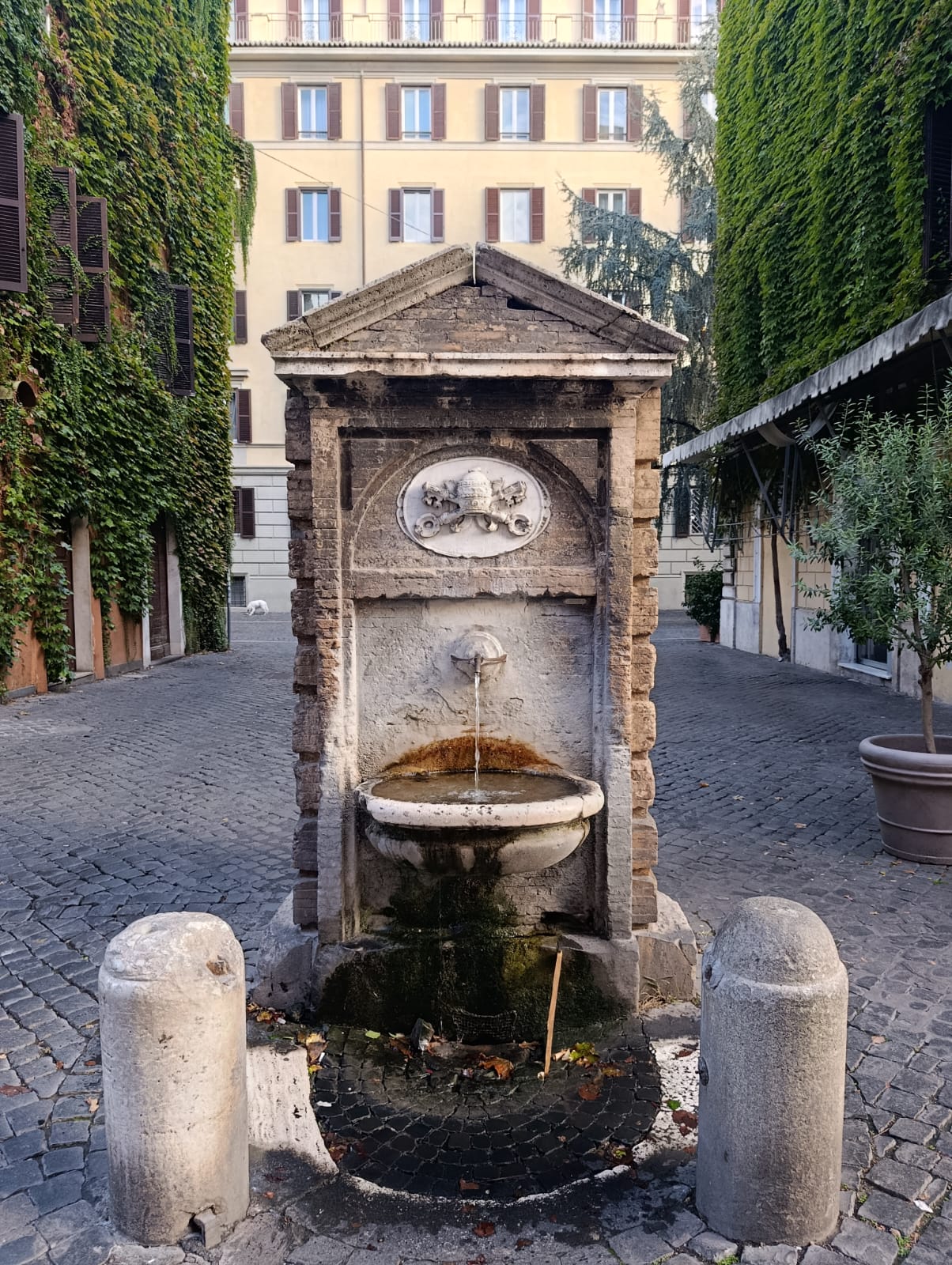
Here, visitors can discover the Fontana del Catalone, a distinctive fountain that stands near the entrance to the square.
Unlike monumental fountains such as the Trevi Fountain, this is a much simpler structure. Built from travertine, it resembles a small architectural shrine, with a rectangular form, a triangular pediment and a papal coat of arms.
Look above the water spout and you will see the inscription Acqua Marcia, referring to the ancient Roman aqueduct whose water supply was restored in the 19th century.
The fountain is believed to have been commissioned around 1870 by Pope Pius IX as part of those restoration works. The water was associated with the name Acqua Pia, in reference to the pope.
It is a small but fascinating example of how ancient Roman engineering, papal history and everyday urban life intersect in Rome.
Why Visit Borgo Pio?
Borgo Pio is an interesting addition to a visit to the Vatican because it offers a different perspective on the area.
While St. Peter’s Basilica attracts visitors with its monumental scale and artistic treasures, Borgo Pio invites you to slow down and look at the details of the surrounding historic district.
Here are three reasons to include it in your itinerary:
- Discover Renaissance Rome: Learn about the urban development projects that shaped the streets around the Vatican.
- Find historical details: Look for the Madonnella, the Fontana del Catalone and the architectural features that tell the story of the district.
- Explore beyond the main monuments: Add a short walk through a historic Roman street to your visit to St. Peter’s Basilica or Castel Sant’Angelo.
Borgo Pio is particularly suitable for visitors who enjoy discovering the stories behind places rather than simply photographing their most famous landmarks.
How to Include Borgo Pio in Your Rome Itinerary
Thanks to its location, Borgo Pio is easy to include in a day spent exploring the Vatican area.
You could begin with St. Peter’s Square and the Basilica, then walk through the surrounding streets before continuing towards Castel Sant’Angelo and Ponte Sant’Angelo.
Alternatively, you can visit Borgo Pio before or after exploring the Vatican Museums, depending on your schedule.
Allow some extra time to look at the buildings and small architectural details along the street. Even a short walk can reveal features that are easy to miss when following a busy sightseeing itinerary.
Because Borgo Pio is close to several major attractions, it works well as part of a wider walking route through this historic corner of Rome.
Discover the Hidden Stories of Rome with Kirba Tours
Rome’s history is not limited to its most famous monuments. Sometimes, the most interesting discoveries are found in a small square, a centuries-old fountain or a religious image tucked away on a street corner.
Borgo Pio is a perfect example: a historic street near the Vatican where Renaissance urban planning, papal history and everyday Roman life come together.
When exploring Rome, take the time to look beyond the main attractions. You may discover that some of the city’s most fascinating stories are hiding in plain sight.