Every October 13, the ancient Romans celebrated Fontinalia, a religious festival dedicated to Fons, the Roman god of springs and fresh water. On this day, wells were decorated with garlands, and wreaths were offered to natural springs as a gesture of reverence for one of life’s most essential resources. Long before Rome became famous for its monumental aqueducts and spectacular fountains, fresh water played a sacred role in Roman religion and everyday life. The Fontinalia festival reminds us that the Romans saw springs not simply as sources of drinking water, but as places worthy of divine protection and ritual honor.
Rome’s relationship with water is still visible in its historic fountains, ancient landscapes, and hilltop viewpoints. Travelers who want to explore this remarkable setting from a different perspective can enjoy the Rome Panoramic Golf Cart Tour with Kirba Tours. This 2.5-hour private sightseeing experience connects some of the city’s most scenic terraces and viewpoints, including the Janiculum Hill, an area closely associated with the ancient cult of Fons. With a local driver, flexible photo stops, and comfortable transportation between viewpoints, the tour offers an enjoyable way to appreciate Rome’s historic landscape without spending hours walking uphill. The itinerary is indicative and may vary.
But who was Fons, and why did the Romans celebrate a festival devoted specifically to springs and wells? To understand Fontinalia, we need to explore Roman mythology, ancient religious traditions, archaeological evidence, and the importance of water in the development of the Eternal City.
What Was Fontinalia in Ancient Rome?
Fontinalia was an ancient Roman religious festival celebrated annually on October 13 in honor of Fons, the deity associated with springs and natural sources of water.
The festival was part of the traditional Roman religious calendar and was recorded in ancient literary sources and inscriptions.
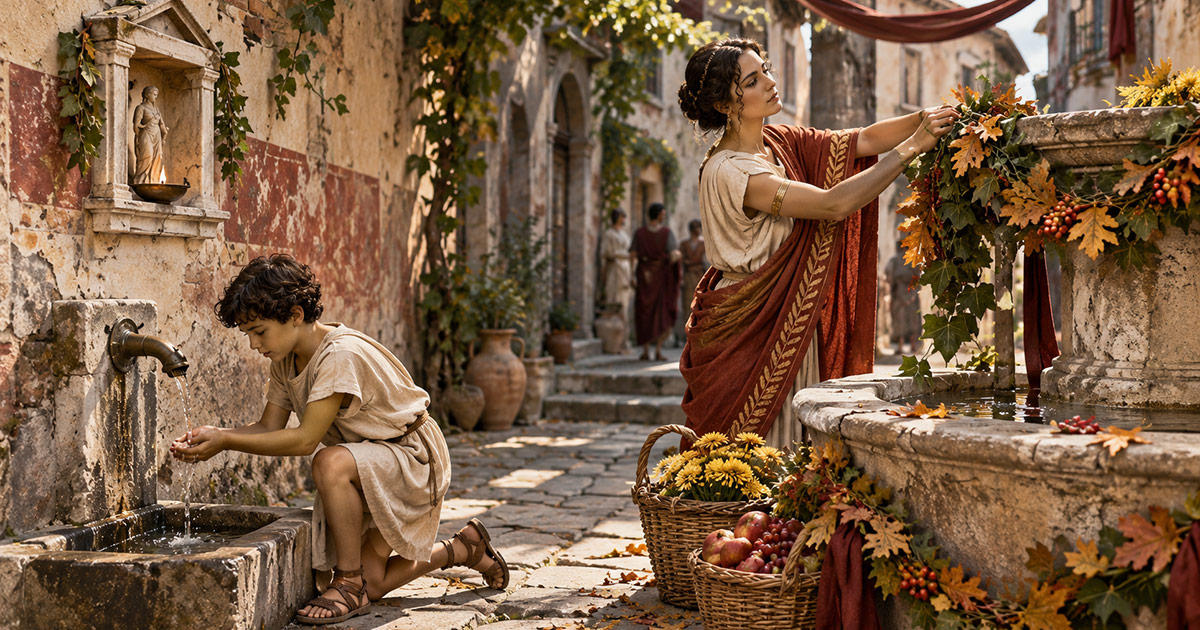
Its central ritual was simple but meaningful: the Romans decorated wells with garlands and cast wreaths into springs.
These offerings acknowledged the importance of freshwater sources to communities that depended on them for drinking, agriculture, animals, and daily household activities.
The name Fontinalia comes from the Latin word fons, meaning spring or fountain.
Fontinalia: Key Historical Facts
- Festival name: Fontinalia, also found in ancient texts as Fontanalia.
- Date: October 13.
- Honored deity: Fons, the Roman god of springs.
- Main documented ritual: Placing garlands on wells and offering wreaths to springs.
- Ancient sources: Varro, Festus, Cicero, and Roman calendar inscriptions.
- Associated sacred places: The altar of Fons near the traditional tomb of Numa and a sanctuary associated with Porta Fontinalis.
Although Fontinalia was connected with a specific deity, its importance extended beyond an individual temple or sanctuary. The festival reflected the broader Roman belief that natural places and essential resources could possess divine significance.
How Did the Romans Celebrate Fontinalia?
Our clearest description of the Fontinalia rituals comes from the Roman scholar Marcus Terentius Varro, who lived during the first century BC.
In De Lingua Latina, Book VI, section 22, Varro explains the festival’s name and describes its most recognizable custom.
He writes:
“In fontes coronas iaciunt et puteos coronant.”
The passage describes wreaths being cast into springs and wells being crowned with garlands.
This brief testimony is one of the most valuable pieces of evidence for the celebration.
Why Were Springs and Wells Decorated With Flowers?
In Roman religious culture, wreaths and garlands were commonly used to honor deities, sacred objects, and important places.
Decorating a spring or well was therefore more than a visual gesture. It symbolically recognized the sacred character of the water source.
Imagine ancient Rome on an October morning: wells adorned with garlands and natural springs marked by offerings from people who depended on their waters.
It is a striking image of how closely religion and everyday survival were connected.
Some later descriptions of Fontinalia include processions, music, statues, or elaborate ceremonies. However, the surviving ancient evidence does not establish all these details with the same certainty as the garland ritual described by Varro.
It is also important not to assume that the festival was necessarily limited to offerings without animal sacrifice. Sacrifices to Fons are documented in other religious contexts, but the exact sacrificial program for Fontinalia is not securely known.
Who Was Fons, the Roman God of Springs?
In Roman mythology, Fons was the divine personification of springs and freshwater sources.
Unlike major deities associated with warfare, political authority, or agriculture, Fons represented a natural resource essential to every community.
His worship illustrates an important characteristic of early Roman religion: different aspects of the natural world could be protected or represented by specific divine powers.
Was Fons the Son of Janus and Juturna?
Some later ancient traditions identify Fons as the son of Janus, the Roman god associated with beginnings, transitions, and doorways.
In a passage by the late antique writer Arnobius, Janus is described as the father of Fons and the husband of Juturna, a water-related divinity.
However, Roman mythological genealogies are not always consistent across authors and periods.
The connection between Janus, Fons, and Juturna should therefore be understood as one ancient tradition rather than a universally accepted family history of the gods.
Fons and the Nymph Juturna
Juturna was another important figure associated with springs and fresh water.
Her cult was especially significant in ancient Rome, where the Lacus Iuturnae, or Spring of Juturna, stood within the Roman Forum.
The spring was associated with religious traditions, healing, and the legendary history of the city.
Although Juturna and Fons belonged to the same wider religious world of sacred water, they were distinct divine figures with their own traditions and places of worship.
The Sacred Altar of Fons on Janiculum Hill
One of the ancient places associated with Fons was an altar near the traditional burial site of Numa Pompilius, Rome’s legendary second king.
The Roman statesman Cicero mentions this altar in De Legibus, Book II, section 56, when discussing traditional burial practices.
According to the tradition he reports, Numa was buried near an altar dedicated to Fons.
This association is particularly meaningful because Numa was remembered as a king who helped establish Rome’s religious institutions and sacred customs.
The traditional location is connected with the Janiculum, one of Rome’s most historically significant hills.
However, the precise archaeological location of the altar and the supposed tomb of Numa has not been securely established.
Janiculum Hill and Rome’s Sacred Landscape
Today, Janiculum Hill is best known for its panoramic views across the rooftops, domes, and monuments of Rome.
Yet the hill also has deep connections with the city’s legendary past, including traditions associated with Janus and Numa.
For travelers interested in ancient Roman history, understanding these associations adds another dimension to the city’s famous viewpoints.
The landscape becomes more than a beautiful place for photographs: it becomes part of the story of how Romans interpreted their surroundings through mythology and religion.
The Temple of Fons and the Porta Fontinalis
The worship of Fons was also associated with a sanctuary near the Porta Fontinalis, an ancient gate in Rome’s defensive walls.
The temple is traditionally linked to Gaius Papirius Maso, a Roman consul whose military campaign in Corsica took place in 231 BC.
Ancient accounts associate the dedication with his victory and with gratitude for the divine protection of a desperately needed water supply.
The sanctuary was reportedly established using resources connected with the Corsican campaign, although the precise date of its dedication is not entirely certain.
Where Was the Porta Fontinalis Located?
The Porta Fontinalis was a gate in the ancient city walls, generally associated with the area between the Capitoline and Quirinal Hills.
Its location is usually discussed in relation to the ancient route leading toward the Campus Martius.
However, the gate’s exact archaeological position remains uncertain.
Ancient literary references and surviving inscriptions provide clues, but they do not identify its location with complete precision.
Scholars have proposed different reconstructions, including an association with the ancient Clivus Argentarius and the beginning of the route later connected with the Via Flaminia.
Some researchers have also explored possible relationships between Porta Fontinalis and earlier defensive structures, including the gate known as Porta Ratumena.
These proposals remain part of historical and archaeological interpretation rather than definitively established facts.
Why Was Water Sacred in Ancient Rome?
To understand the significance of Fontinalia, it is useful to remember that water shaped the growth and survival of Rome long before the city became famous for its impressive aqueduct system.
Early communities depended on natural springs, wells, rivers, and collected rainwater.
These sources supplied water for drinking, cooking, animals, and other everyday needs.
Although the Romans later developed sophisticated aqueducts that transformed urban life, natural water sources retained both practical and religious importance.
Water was also closely associated with purification, healing, fertility, and divine protection.
Several Roman deities and nymphs were connected with particular springs, streams, or bodies of water, reflecting the importance of these places in local religious traditions.
From Sacred Springs to Roman Aqueducts
Rome’s first aqueduct, the Aqua Appia, was constructed in 312 BC.
Over time, the city developed an extensive water supply network that supported public baths, private houses, fountains, and other urban infrastructure.
Yet the existence of aqueducts did not erase the older religious traditions surrounding springs and wells.
Fontinalia demonstrates how a technically advanced civilization could continue to honor the natural sources that had sustained its earliest communities.
The Spring of Juturna in the Roman Forum
One of the most important surviving examples of sacred water in ancient Rome is the Spring of Juturna, known in Latin as the Lacus Iuturnae.
Located within the archaeological area of the Roman Forum, near the Temple of Castor and Pollux, this spring was associated with the nymph Juturna.
Its surviving architectural remains provide tangible evidence of the important place natural springs occupied in Roman religious life.
The site developed into a monumental sacred complex and underwent changes during different periods of Roman history.
Although the spring was dedicated to Juturna rather than Fons, it helps modern visitors understand the religious environment in which festivals such as Fontinalia developed.
For more historical and archaeological context, the official Colosseum Archaeological Park website provides information about the sacred spring and its place within the Roman Forum.
Did Fontinalia Have a Connection to Emperor Claudius?
An interesting historical coincidence links October 13 to one of the most consequential events in imperial Roman history.
Emperor Claudius died on October 13, AD 54, the same calendar date on which the Romans celebrated Fontinalia.
His death brought Nero to the imperial throne, marking the beginning of a new and turbulent period in Roman history.
However, there is no established evidence that Claudius’s death was connected to the religious significance of Fontinalia.
The overlap is best understood as a coincidence of dates rather than a historical relationship between the emperor and the festival of springs.
How Fontinalia Helps Us Understand Ancient Roman Religion
Fontinalia provides a valuable reminder that Roman religious life was not centered exclusively on grand temples or famous gods such as Jupiter, Mars, and Venus.
Many religious traditions focused on smaller, everyday elements of the environment.
Springs, wells, trees, crossroads, and agricultural boundaries could all carry sacred meaning.
The Fontinalia festival illustrates three particularly important aspects of Roman religion:
- Respect for natural resources: Freshwater sources were recognized as essential to the community.
- Rituals connected with everyday life: Religious observances often centered on places people encountered regularly.
- Continuity between public religion and local traditions: The worship of Fons belonged to a wider religious landscape that included numerous sacred springs and water-related deities.
The simplicity of the garland ritual is part of what makes the festival so distinctive.
Without elaborate architectural settings or surviving descriptions of large ceremonial performances, it still communicates a clear message: water was valuable enough to be honored through religious observance.
Frequently Asked Questions About Fontinalia
What was Fontinalia?
Fontinalia was an ancient Roman religious festival dedicated to Fons, the god of springs and freshwater sources. Its best-documented ritual involved decorating wells and offering garlands to springs.
When was Fontinalia celebrated?
Fontinalia was celebrated every year on October 13 in the ancient Roman religious calendar.
Who was Fons in Roman mythology?
Fons was the Roman deity associated with natural springs and sources of fresh water. Some later traditions identified him as a son of Janus.
What did Romans do during Fontinalia?
According to Varro, Romans placed garlands on wells and cast wreaths into springs. These offerings honored the sacred nature of freshwater sources.
Where was the temple of Fons located?
A sanctuary dedicated to Fons was associated with the area outside the ancient Porta Fontinalis, near the Capitoline and Quirinal Hills. Its exact archaeological location remains uncertain.
What was the connection between Fons and Janiculum Hill?
Ancient tradition placed an altar of Fons near the supposed tomb of Numa Pompilius, a location associated with the Janiculum area. Cicero preserves a reference to the altar and the traditional burial site.
Are Fontinalia and the worship of Juturna the same thing?
No. Fontinalia was dedicated to Fons, while Juturna was a separate divine figure associated with springs and water. Both belonged to the wider religious traditions surrounding sacred freshwater sources.
Is Fontinalia still celebrated in Rome today?
Fontinalia is primarily studied today as a festival of ancient Roman religion rather than a regularly observed official public celebration. Its history can still be explored through ancient texts and archaeological sites associated with Rome’s sacred water traditions.
Fontinalia: When Ancient Rome Honored Its Springs
The Fontinalia festival offers a fascinating perspective on ancient Roman life, revealing a world in which natural springs and wells were not merely practical resources but also sacred places deserving honor and protection.
Each October 13, the act of decorating wells with garlands and offering wreaths to springs expressed a relationship between human communities, nature, and the divine.
From the traditions surrounding Fons and Janiculum Hill to the sanctuary near Porta Fontinalis, the festival connects mythology with the physical landscape of ancient Rome.
Its surviving evidence may be limited, but the message remains powerful: long before monumental aqueducts and elaborate fountains became symbols of Roman engineering, the city’s relationship with fresh water was already deeply rooted in religious tradition.
Understanding Fontinalia adds another layer to the experience of Rome, a city where ancient beliefs, historical landscapes, and the enduring presence of water continue to tell stories across thousands of years.
Historical Sources and Further Reading
- Varro, De Lingua Latina, Book VI, Section 22 — Primary ancient testimony concerning the Fontinalia ritual.
- Cicero, De Legibus, Book II, Section 56 — Ancient reference to the altar of Fons near the traditional tomb of Numa.
- Oxford Classical Dictionary: Fontinalia — Scholarly overview of the festival, deity, and associated traditions.
- Digital Augustan Rome: Porta Fontinalis — Historical and topographical discussion of the ancient city gate.