The Church of Sant’Ivo alla Sapienza in Rome, one of the most remarkable masterpieces of Baroque architecture, has officially reopened to visitors on October 27, 2026, following years of closure and an extensive restoration. Designed by the celebrated architect Francesco Borromini, this extraordinary church is famous for its distinctive spiral lantern, intricate star-shaped floor plan, and luminous white interior. Hidden inside the historic Palazzo della Sapienza, just steps from Piazza Navona, Sant’Ivo alla Sapienza is once again welcoming visitors with free admission and regular weekday opening hours.
Visiting Sant’Ivo alla Sapienza is also a wonderful opportunity to explore Rome’s historic center. Travelers interested in discovering the city’s celebrated landmarks and lesser-known architectural treasures can consider private tours of Rome with Kirba Tours, featuring knowledgeable local guides and experiences focused on the city’s history, art, and cultural heritage. For visitors who prefer a more comfortable way to explore multiple attractions, Rome golf cart tours offer an enjoyable sightseeing alternative with less walking between stops. Admission to Sant’Ivo itself remains subject to the church’s official opening hours and access arrangements.
But what makes Sant’Ivo alla Sapienza so exceptional? Why is its spiral dome considered one of Borromini’s greatest architectural achievements? And how can you visit this remarkable church now that it has reopened? Here is everything you need to know about its history, architecture, hidden symbolism, restoration, and practical visitor information.
Sant’Ivo alla Sapienza Reopens in 2026: Hours, Admission, and Visitor Information
After being closed to regular visitors for many years, Sant’Ivo alla Sapienza reopened on October 27, 2026, thanks to a collaboration between the Italian Ministry of Culture’s archival authorities, the State Archives of Rome, the Diocese of Rome, and the Touring Club Italiano.
The reopening is part of “Aperti per voi” (Open for You), an initiative organized by the Touring Club Italiano that involves trained volunteers in welcoming visitors and helping preserve and promote Italy’s cultural heritage.
Sant’Ivo alla Sapienza Opening Hours
- Address: Corso del Rinascimento 40, 00186 Rome, Italy.
- Reopening date: October 27, 2026.
- Visiting days: Monday through Friday.
- Opening hours: 9:30 AM to 1:30 PM.
- Admission: Free.
- Entrance: Through the courtyard of Palazzo della Sapienza.
- Visitor assistance: Touring Club Italiano volunteers.
The official reopening announcement does not specify a mandatory reservation for ordinary visits. However, visitors should check for possible changes to opening hours, holidays, or special events before arriving.
For the most reliable information, consult the official State Archives of Rome announcement.
Travel tip: Plan your visit during the morning and allow enough time to appreciate the architecture without rushing. The church is particularly rewarding for visitors interested in Baroque architecture, Renaissance and early modern history, and the work of Francesco Borromini.
Where Is Sant’Ivo alla Sapienza Located in Rome?
Sant’Ivo alla Sapienza is located in the Sant’Eustachio neighborhood, in the heart of Rome’s historic center, inside the former university complex known as Palazzo della Sapienza.
The church stands along Corso del Rinascimento, within easy walking distance of the Pantheon and Piazza Navona.
Unlike many of Rome’s monumental churches, Sant’Ivo does not have a grand entrance directly facing a busy square. Instead, visitors enter the historic palace and cross its elegant courtyard before reaching the church.
This architectural arrangement is an essential part of the experience.
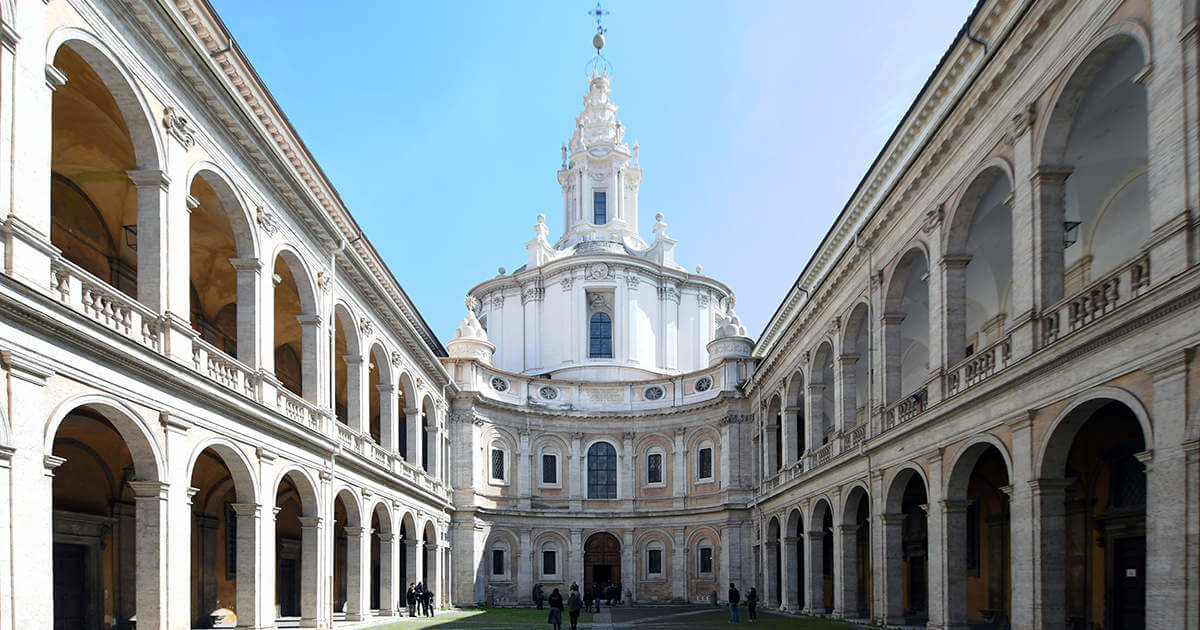
The courtyard, with its two levels of arcades, creates a carefully organized visual approach to the church’s concave façade. Above it rises the unmistakable spiral lantern designed by Borromini, one of the most recognizable features of Rome’s Baroque skyline.
The contrast between the lively city streets outside and the quiet, enclosed courtyard makes the discovery even more memorable.
The History of Sant’Ivo alla Sapienza
The history of Sant’Ivo alla Sapienza is closely connected with the development of the University of Rome and the artistic ambitions of the papacy during the 17th century.
The Palazzo della Sapienza complex was created to bring together university activities that had previously occupied different buildings around the city.
When Borromini became involved in the project, much of the surrounding palace had already been planned or constructed.
Francesco Borromini and the Sapienza Project
In 1632, Francesco Borromini was appointed architect of the Sapienza complex during the papacy of Urban VIII Barberini.
His assignment was unusually demanding. He had to complete the existing university building while designing a church within an architectural framework that had already been established.
The courtyard and several principal features of the palace had been designed by Giacomo della Porta.
Rather than ignoring these limitations, Borromini transformed them into an opportunity for experimentation.
The church’s construction developed primarily between 1642 and 1660, during a period when Borromini was also working on other major projects that would help define the visual identity of Baroque Rome.
His approach differed significantly from that of Gian Lorenzo Bernini, his famous contemporary and artistic rival.
Where Bernini frequently emphasized theatrical effects, sculptural drama, and monumental compositions, Borromini explored intricate geometry, complex spatial relationships, and innovative architectural forms.
At Sant’Ivo alla Sapienza, those interests came together in an exceptionally original design.
Why Is the Church Called Sant’Ivo alla Sapienza?
The church is dedicated to Saint Ivo of Kermartin, also known as Saint Ivo Hélory, a medieval saint traditionally recognized as the patron saint of lawyers and legal professionals.
The dedication was especially appropriate for a university complex where law and legal studies played an important role.
The word Sapienza means “wisdom” in Italian and refers to the historic university institution associated with the complex.
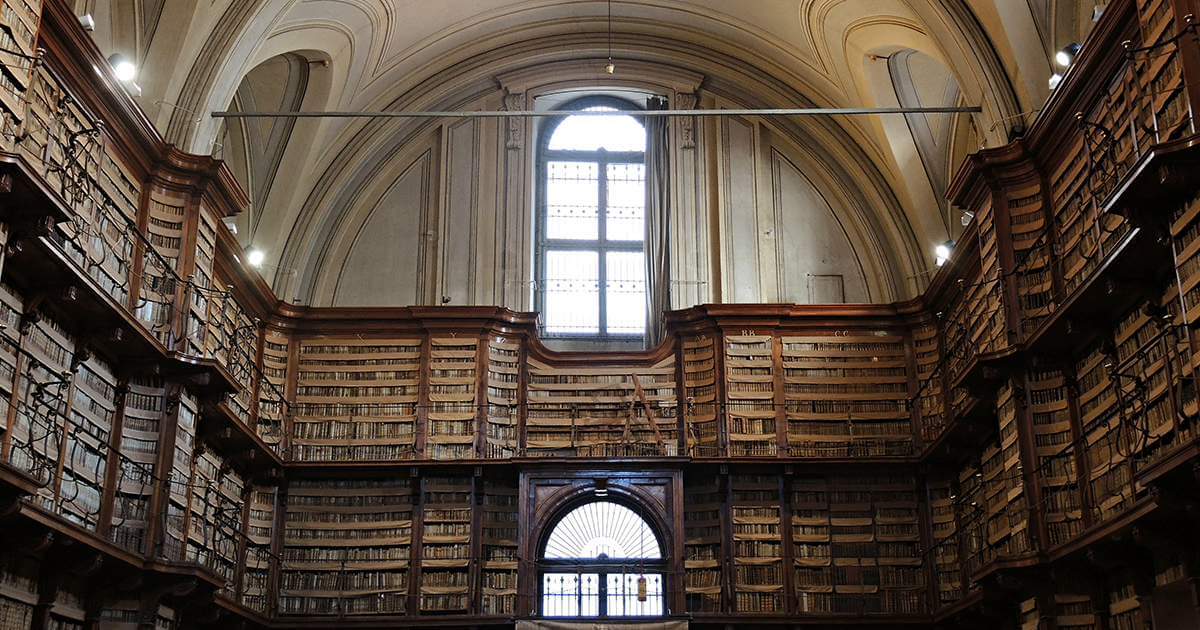
Today, the building houses the State Archives of Rome, which have occupied the complex since 1935.
The Architecture of Sant’Ivo alla Sapienza: Borromini’s Baroque Genius
What makes Sant’Ivo alla Sapienza one of the greatest achievements of Roman Baroque architecture is Borromini’s extraordinary ability to transform mathematical geometry into a dynamic, harmonious, and seemingly weightless space.
Unlike churches that rely heavily on colorful marble, gilded ornamentation, or elaborate sculptural decoration, Sant’Ivo achieves much of its visual impact through architectural form, light, and spatial rhythm.
The Six-Pointed Star Floor Plan
One of the church’s most fascinating features is its unusual floor plan.
Borromini developed a centralized design based on the intersection of two equilateral triangles, creating a geometric pattern associated with a six-pointed star.
He then modified this underlying geometry through alternating concave and convex curves, producing walls that seem to expand and contract as they move around the interior.
The result is a space that feels both mathematically precise and remarkably fluid.
Instead of presenting visitors with a conventional rectangular or circular church, Borromini created a sophisticated architectural composition in which the boundaries between individual surfaces seem to dissolve.
This geometry is not merely decorative. It is fundamental to the building’s structural organization, visual effect, and symbolic meaning.
The Interior: White Surfaces, Geometry, and Natural Light
Entering Sant’Ivo alla Sapienza Church reveals a striking contrast with the richly decorated interiors found in many other Roman Baroque churches.
The dominant impression is one of brightness and clarity.
White architectural surfaces, fluted pilasters, carefully proportioned cornices, and gently curving walls create a unified composition that directs the eye upward toward the dome.
Natural light interacts with these surfaces throughout the day, emphasizing their curves and creating subtle variations in shadow.
Although the church is relatively compact, its vertical design gives the interior an unexpected sense of height and openness.
Borromini also designed the striking black-and-white marble floor, reinforcing the geometric relationships that organize the entire building.
The Altarpiece by Pietro da Cortona
Among the artworks inside the church is the main altarpiece dedicated to Saint Ivo, begun by Pietro da Cortona, another leading figure of the Roman Baroque.
The painting remained unfinished at the artist’s death and was subsequently completed by his followers.
It provides an important figurative element within a space where architecture remains the dominant artistic expression.
The Dome and Spiral Lantern of Sant’Ivo alla Sapienza
The dome of Sant’Ivo alla Sapienza is undoubtedly its most famous architectural feature and one of the most distinctive creations of Francesco Borromini.
Viewed from the courtyard, the dome rises above the church’s concave façade before culminating in an extraordinary spiral lantern.
Its unusual silhouette has fascinated historians, architects, and visitors for centuries.
What Does the Spiral Lantern Symbolize?
The lantern features a dramatic helical form that appears to twist upward toward the sky.
This ascending movement has inspired several symbolic interpretations, including associations with the Tower of Babel, the Lighthouse of Alexandria, and the spiritual ascent toward divine wisdom.
These interpretations reflect the intellectual richness of Borromini’s architecture, although scholars do not necessarily agree that every proposed symbolic meaning represents the architect’s original intention.
The lantern is decorated with architectural pinnacles, travertine flames, and an elaborate crowning composition that includes a sphere, a cross, and a dove carrying an olive branch.
Together, these elements create a remarkable impression of vertical movement and lightness.
Even from a distance, the spiral lantern remains one of the most recognizable architectural details in Rome.
Why Is Borromini’s Dome So Innovative?
Traditional domes frequently rise above clearly defined structural supports and transitional architectural elements.
At Sant’Ivo alla Sapienza, Borromini developed a more integrated relationship between the church’s unusual floor plan, its curving walls, and the dome above.
The complex geometry of the interior appears to continue naturally upward.
As the walls rise, the spatial composition gradually changes, creating a smooth visual progression toward the lantern.
This transformation of geometry into movement is one of the reasons Sant’Ivo is regarded as such an important achievement in architectural history.
Hidden Symbols Inside Sant’Ivo alla Sapienza
Borromini’s architecture is often associated with elaborate religious, mathematical, and heraldic symbolism.
At Sant’Ivo alla Sapienza, the building’s geometry has inspired numerous interpretations connecting architectural order with Christian theology and the concept of divine wisdom.
The Triangle and the Holy Trinity
The triangle, one of the fundamental shapes underlying the church’s design, is traditionally associated with the Holy Trinity.
The intersection of two triangles and the repetition of geometric patterns can be interpreted as part of a symbolic system connecting mathematical harmony with spiritual perfection.
These ideas reflect the importance of geometry in Borromini’s architectural thinking and the broader religious culture of 17th-century Rome.
The Barberini Bees and Chigi Heraldry
The church also preserves decorative references to the papal families involved in the history of the complex.
The Barberini bees recall Pope Urban VIII, while eight-pointed stars and heraldic mountains refer to the Chigi family and Pope Alexander VII.
These details offer a visual connection between the building’s architectural development and the papal patronage that shaped Rome during the Baroque period.
Understanding this symbolism helps visitors appreciate Sant’Ivo not simply as an architectural experiment but also as a sophisticated expression of religion, scholarship, and political history.
The Restoration of Sant’Ivo alla Sapienza
The church’s reopening in October 2026 follows an extensive restoration program aimed at preserving the monument and recovering the clarity of Borromini’s original architectural vision.
The work was carried out under the supervision of Rome’s heritage authorities, with support from Italy’s National Recovery and Resilience Plan through the Caput Mundi program.
The restoration involved several important aspects of the building, including:
- Cleaning and consolidation of interior and exterior architectural surfaces.
- Restoration of the church’s characteristic white finishes.
- Conservation work on the dome and spiral lantern.
- Repairs to roofing and rainwater drainage systems.
- Restoration of the main altarpiece by Pietro da Cortona.
Recovering the subtle tones of Borromini’s architectural surfaces was particularly important because the color and texture of the walls directly influence how natural light defines the space.
According to the Italian Ministry of Culture, the restoration also addressed water infiltration and the preservation of the church’s distinctive architectural details.
The reopening allows visitors to experience the relationship between geometry, light, and architectural movement with renewed clarity.
What to Look for When Visiting Sant’Ivo alla Sapienza
To fully appreciate Borromini’s masterpiece, take time to observe several architectural details during your visit.
- The courtyard of Palazzo della Sapienza: Notice how the arcades frame the church’s concave façade and establish a carefully balanced architectural composition.
- The spiral lantern: Look upward before entering and follow the movement of the lantern as it twists toward the sky.
- The star-shaped floor plan: Inside, observe how concave and convex walls create a constantly changing sense of space.
- The dome: Pay attention to how the walls transition into the overhead structure.
- Natural light: Notice how subtle changes in brightness emphasize the curves and architectural details.
- The marble floor: Look for the geometric patterns that reinforce Borromini’s carefully organized design.
- The main altarpiece: Admire Pietro da Cortona’s contribution to the church’s artistic program.
Rather than treating these features as separate decorative details, try to see how they work together.
The genius of Sant’Ivo alla Sapienza lies in the unity of its design: every curve, proportion, and transition contributes to the overall architectural experience.
How to Include Sant’Ivo alla Sapienza in Your Rome Itinerary
Thanks to its central location, Sant’Ivo alla Sapienza can fit naturally into a morning devoted to Rome’s history and Baroque architecture.
The church is conveniently located near several famous landmarks, making it an excellent addition to a walking itinerary through the historic center.
Visitors interested in architecture may find it especially rewarding to compare Borromini’s work with other monuments from the same period.
For example, the surrounding historic center offers opportunities to explore works associated with Gian Lorenzo Bernini, Pietro da Cortona, and other influential artists and architects of Baroque Rome.
If your time is limited, focus on the church and its magnificent courtyard. If you have a longer stay, combine the visit with other cultural attractions in the surrounding neighborhood.
Important: Sightseeing experiences offered by private tour operators are separate from the free public admission to Sant’Ivo alla Sapienza. Any proposed visit to the church must respect the official opening hours and should be confirmed with the tour provider when relevant.
Frequently Asked Questions About Sant’Ivo alla Sapienza
When did Sant’Ivo alla Sapienza reopen?
Sant’Ivo alla Sapienza reopened on October 27, 2026, after years of closure and an extensive restoration project.
What are the opening hours of Sant’Ivo alla Sapienza?
The announced visiting hours are Monday through Friday, from 9:30 AM to 1:30 PM. Visitors should check for possible changes during public holidays or special events.
Is Sant’Ivo alla Sapienza free to visit?
Yes. According to the official reopening announcement, admission to Sant’Ivo alla Sapienza is free.
Do you need a reservation to visit Sant’Ivo alla Sapienza?
The official reopening announcement does not specify a mandatory reservation for ordinary visits. Check the State Archives of Rome website for the latest visitor information.
Where is Sant’Ivo alla Sapienza located?
The church is located at Corso del Rinascimento 40, Rome, Italy, inside Palazzo della Sapienza in the Sant’Eustachio neighborhood, near Piazza Navona.
Who designed Sant’Ivo alla Sapienza?
The church was designed by Francesco Borromini, one of the most influential architects of the Roman Baroque. Its construction took place primarily between 1642 and 1660.
Why is Sant’Ivo alla Sapienza famous?
The church is celebrated for its six-pointed star floor plan, alternating concave and convex walls, extraordinary dome, and distinctive spiral lantern.
What does Borromini’s spiral lantern represent?
The lantern has been interpreted as a symbol of spiritual ascent and divine wisdom. Architectural historians have proposed connections with the Tower of Babel and the Lighthouse of Alexandria, although these interpretations are not universally accepted.
Why was Sant’Ivo alla Sapienza closed?
The church had been closed to regular public access for many years and underwent an extensive restoration program designed to conserve its architecture and historic surfaces.
Why Sant’Ivo alla Sapienza Deserves a Place on Your Rome Itinerary
The reopening of Sant’Ivo alla Sapienza is one of Rome’s most important cultural developments of 2026, particularly for travelers interested in architecture, history, and lesser-known landmarks.
Its significance goes far beyond the famous spiral lantern.
From the unusual star-shaped floor plan to the extraordinary dome, every part of the church demonstrates Francesco Borromini’s ability to transform geometry, light, and architectural form into a deeply original artistic language.
Visiting Sant’Ivo means discovering a monument that helped redefine Baroque architecture while experiencing a remarkable historic setting just steps away from some of Rome’s busiest attractions.
Make time to visit Sant’Ivo alla Sapienza during your next trip to Rome and discover one of Borromini’s most extraordinary achievements, now open to the public once again.
Visitor information updated October 27, 2026. Opening hours and access arrangements may change. For current details, consult the official State Archives of Rome website.
Di Paris Orlando – Opera propria, CC BY-SA 4.0, Collegamento