Walk into the church of San Paolo alle Tre Fontane, in the abbey complex south of Rome’s center, and look down. The nave floor holds a polychrome Roman mosaic of the second century AD, with the four seasons personified as busts in its corners, each one labeled in Latin. It was laid at Ostia, Rome’s ancient port, and found there in 1864 beside a mithraeum. Three years later it was given to this church and reinstalled, and visitors still cross a pavement roughly eighteen centuries old without noticing it.
A floor like this makes more sense with someone who can explain how it got here. Our private Rome tours are led by expert local guides who take you inside the Colosseum for the real history of the games and stand with you under the open oculus of the Pantheon. The walk through the historic center passes Piazza Navona, the Trevi Fountain and the Spanish Steps, with your guide explaining what you are actually looking at. You can add a gladiator training session or a hands-on Italian cooking class with a local cook. The tours are private, so the route and the pace follow your group’s interests, which works equally well for couples, families and friends.
What Is the Mosaic of the Seasons from Ostia?
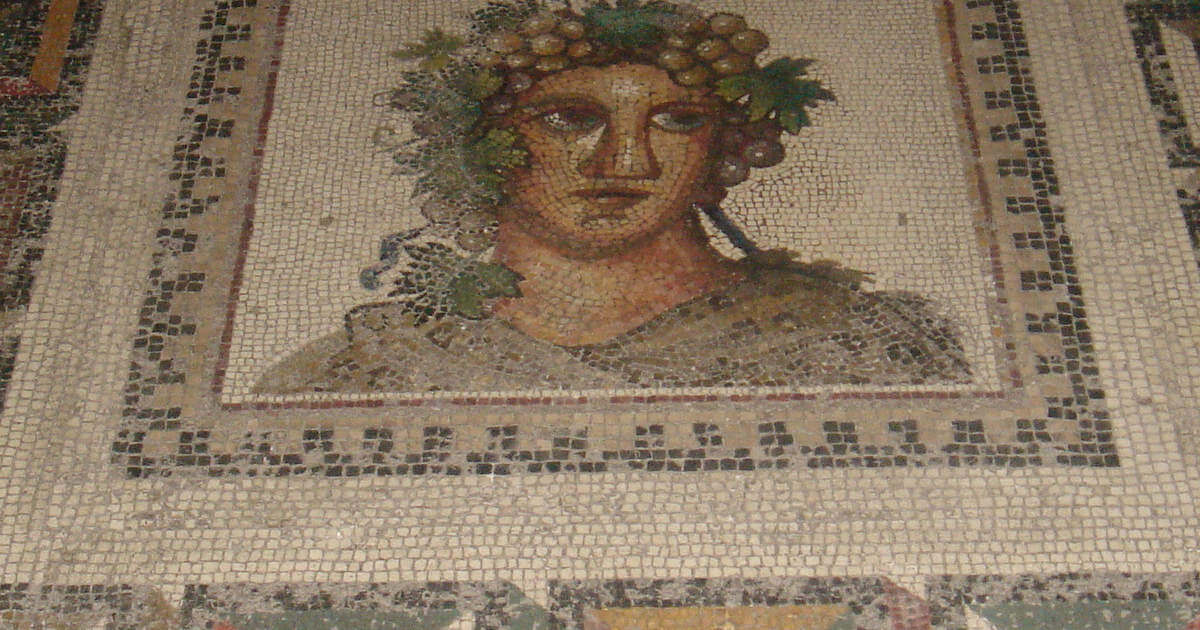
The work is a figurative floor mosaic in color, built around a central rectangular field with four corner panels and framed by a perspective meander border. Each corner panel holds the bust of one season, and each bust carries its name in Latin: HIEMS (Winter), VER (Spring), AVTV, an abbreviated or damaged form of Autumnus (Autumn), and AESTAS (Summer).
Roman seasonal mosaics often identify their figures through attributes alone, which leaves modern viewers arguing over which corner is which. Here the names are written into the floor, so there is nothing to argue about.
Quick Identification
- Subject: personifications of the four seasons, shown as busts.
- Composition: a central rectangle with four corner panels, enclosed by a perspective meander.
- Technique: polychrome mosaic, in contrast with the black-and-white floors that dominate much of Ostia.
- Reported date: second century AD.
- Findspot: Ostia Antica, in a room near the mithraeum of the building known as the Imperial Palace, discovered in 1864.
- Present location: the nave floor of San Paolo alle Tre Fontane, Rome, where it was installed in 1867.
- Recorded size: approximately 5.63 by 4.80 meters, roughly 18 by 16 feet, according to the Ostia Antica scholarly database.
That last figure is worth pausing on. The mosaic covers roughly the footprint of a modest American living room, and you stand beside it rather than peer at it through glass.
Reading the Four Figures
The four faces are handled differently from one another. Each season has its own palette, and the color does most of the identifying work that the labels then confirm.
Autumn
Autumn wears a spotted animal skin in tones that run between brown and yellow, with inserts of gray. The head is turned slightly to the right, and the face is dominated by large blue eyes. On the head sits a crown of vine leaves heavy with grapes, the clusters rendered with full, swollen berries. It is the most immediately readable of the four, since the grape harvest was the standard Roman shorthand for the season.
Summer
Summer is the warmest of the group. Gold and red dominate the tesserae, and the head is encircled by a crown of ripe wheat ears. Autumn’s vintage and Summer’s grain harvest were the two moments of the Roman agricultural year that mattered most to a city fed through Ostia.
Spring
Spring is the palest of the four, worked in soft, muted colors and crowned with small wildflowers instead of a heavy wreath. It is the quietest panel in the set, and the drop from Summer’s gold is immediate.
Winter
Winter is completely covered in marsh leaves, and the gray-green of that covering runs into the shading of the face, so that the figure and its attribute share one tonal range. The cold comes entirely from the color.
From Ostia to Rome: How the Mosaic Traveled
Where the mosaic came from, and where it went, explains why looking for it at the archaeological park gets you nowhere.
Found Beside a Mithraeum
The mosaic came to light in 1864, in a room near the mithraeum of the large complex at Ostia known as the Palazzo Imperiale, or Imperial Palace. The building stands in the western part of the ancient city, a short distance from the course of the Tiber, and it was excavated across the middle decades of the nineteenth century by Pietro Ercole Visconti and Carlo Ludovico Visconti. The mithraeum itself is reported to have been found during the 1860 to 1861 campaign, and according to a dedicatory inscription set into its black-and-white mosaic floor it was built in 162 AD.
The 162 AD date belongs to the mithraeum, not to the Seasons mosaic. The two came from the same complex and share a general second-century horizon, but the inscription dates the shrine. The Seasons floor is dated to the second century on separate grounds. Sources that merge the two into one date are overstating what the evidence says.
A Papal Gift in 1867
In 1867 the mosaic was installed in the nave of San Paolo alle Tre Fontane. It was donated to the church by Pope Pius IX, at a moment when the building was being restored thanks to a substantial gift from Count de Maumigny. Moving an ancient floor into a working church was ordinary practice in nineteenth-century Rome, and it puts the mosaic in the long tradition of spolia, the reuse of older material in newer buildings. The travertine facade of Sant’Agostino near Piazza Navona was quarried out of the Colosseum. Columns lifted from pagan temples hold up basilicas across the city.
The church sits inside the Tre Fontane abbey complex in Rome’s Ardeatino quarter, on the traditional site of the martyrdom of Saint Paul, and it was rebuilt at the end of the sixteenth century by Giacomo della Porta under Cardinal Pietro Aldobrandini. That puts the mosaic in the southern belt of the city, the stretch of suburban Rome crossed by the ancient consular roads. If that landscape interests you, a private Appian Way tour covers it properly, with ancient tombs, aqueducts, catacombs and the country villas that once belonged to Roman aristocrats, the same mix of monuments and open country that surrounds Tre Fontane.
Why a Colored Mosaic Stands Out at Ostia
Visitors who have walked Ostia Antica often come away with an impression of black-and-white floors: geometric patterns, marine creatures, the Baths of Neptune, the business emblems in the Square of the Corporations. The impression is understandable, and the reality is wider than that.
Ostia’s mosaics cover a broad thematic range, including daily life, rural work and agriculture, athletics, commerce and the provisioning trade that was the port’s reason for existing, and mythological subjects. Colored figurative mosaics were used more often by wealthier patrons and reflect the influence of Hellenistic figurative culture. The Seasons mosaic belongs to that more expensive end of the spectrum, which is consistent with its findspot in a large and well-appointed complex.
None of that tells us who paid for the Seasons mosaic, which room it originally decorated, or what it meant to the people who used that room. Those questions are still open.
Do Not Confuse It with Other Four Seasons Mosaics
“Four Seasons” was one of the most common subjects in Roman floor decoration across the empire, which makes image searches confusing. Results for the phrase regularly return a Four Seasons mosaic from Haidra in Tunisia, among others. It is a separate work with its own history, and the shared subject tells you nothing about the Ostia floor.
To confirm you have found the right mosaic, check these together rather than relying on the title:
- Does the source tie it specifically to Ostia, and name the findspot near the mithraeum of the Palazzo Imperiale?
- Does the composition show four corner busts around a central rectangle, inside a perspective meander?
- Are the Latin labels HIEMS, VER, AVTV and AESTAS visible or recorded?
- Does the source separate the findspot at Ostia from the present location in Rome, instead of collapsing both into the phrase “from Ostia”?
A page that gets all four right is describing this mosaic. A page that only says “Roman Four Seasons mosaic” could be describing any of dozens.
Seeing the Mosaic Today
The Church of San Paolo alle Tre Fontane
The mosaic is in the nave floor of San Paolo alle Tre Fontane, at Via di Acque Salvie 1, inside the Tre Fontane abbey complex in southern Rome. The abbey is run by Trappist monks, and the church is an active place of worship rather than a museum, which has a few practical consequences for visitors:
- Dress modestly, with shoulders and knees covered, as in any Roman church.
- Keep your voice down and stay clear of any service in progress.
- Check current hours before you travel. Abbey churches keep their own schedules, often with a long midday closure, and these change seasonally. Confirm on the abbey’s own information before setting out.
- Allow more than the fifteen minutes the mosaic itself takes. The abbey grounds hold three churches and are worth the walk.
- The complex sits in the Ardeatino quarter, well south of the historic center, so plan it as its own trip instead of squeezing it between the Colosseum and the Pantheon.
Can You See It at Ostia Antica?
No. The Ostia connection sends a lot of people looking for it at the archaeological park, and the mosaic has not been there since the 1860s. It is not on the in-situ mosaic route, and walking the park will never bring you to it.
Ostia Antica is worth a day on its own. It is one of the best-preserved Roman towns anywhere, closer to Rome than Pompeii and far less crowded, with streets, apartment blocks, baths, a theater and a great many mosaics still in place. Go there for those, and come to Tre Fontane for the Seasons.
Why Some Ostia Floors Are Covered in Winter
The archaeological park covers vulnerable mosaics with protective sheeting through the winter months, typically from December, with the coverings expected to come off around mid-March or whenever spring conditions allow. The sheets reduce exposure to frost and moisture and help keep the temperature at the mosaic surface more stable.
Those dates are an expectation, since weather varies year to year, and a covering is preventive maintenance on a floor in good condition. None of it applies to the Seasons mosaic, which has been indoors in a Roman church for more than a century and a half. If you are planning a winter visit to Ostia itself, check the park’s current updates for which floors are visible on your dates.
Why the Floor Is Worth the Trip
A second-century pavement from a port town, found next to a shrine to a Persian god, given away by a pope in 1867, and still underfoot in a Trappist church today. Four busts, four crowns, four Latin words, all of it still where the nineteenth century put it.
Pair a morning in the ancient center with an afternoon in the city’s southern archaeological belt, and bring a guide who can explain how a Roman floor ended up in a Christian nave, and why Rome did the same thing a hundred other times.
Lalupa, CC BY-SA 3.0, via Wikimedia Commons