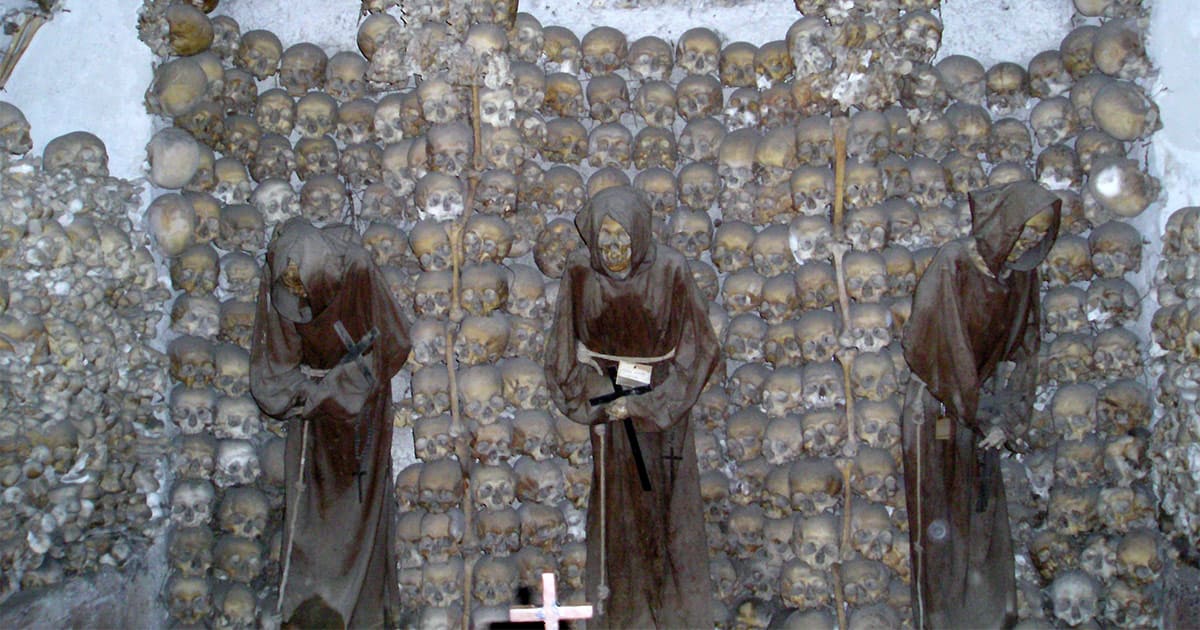
Beneath the elegant cafes and grand hotels of Via Veneto, the boulevard Fellini made famous in La Dolce Vita, lies one of the strangest and most moving places in the city. The Capuchin Crypt in Rome is a series of six small underground chapels decorated, floor to ceiling, with the bones of roughly 3,700 Capuchin friars who died between 1528 and 1870. Chandeliers made of vertebrae hang from ceilings paved with skulls. Arches are built from stacked pelvises. Whole robed skeletons stand in niches like silent sentries. It sounds like a horror set, but the friars did not build it to frighten anyone. They built it as a sermon in bone, a reminder that every visitor walking through will one day share the same fate.
If this kind of sacred art and history draws you in, Rome offers no shortage of it, and the crypt pairs naturally with the city’s greatest religious masterpieces. Many travelers combine an afternoon here with a private Vatican, Sistine Chapel, and St. Peter’s Basilica tour, moving from the humble bones of the Capuchins to Michelangelo’s ceiling and Bernini’s bronze canopy. Others focus on a single monument with a St. Peter’s Basilica private tour, standing before Michelangelo’s Pietà and the Baldacchino at the heart of Catholicism. Seen together, these sites tell one continuous story about how Rome has always confronted mortality, faith, and eternity.
What Is the Capuchin Crypt?
The crypt sits beneath the Church of Santa Maria della Concezione dei Cappuccini, near Piazza Barberini. It is an ossuary, a place where human bones are stored and, in this case, arranged into decorative and symbolic patterns. It is not a typical museum exhibit and it was never meant to be a tourist attraction. It was, and in a sense still is, a place of religious reflection.
The bones belong overwhelmingly to Capuchin friars, members of a branch of the Franciscan order known for their poverty, humility, and brown hooded robes. When the friars first moved to the site in 1631, they brought with them the remains of their brothers from an earlier friary, and over the following centuries the crypt filled with the dead. The arrangement of those remains into intricate designs turned a simple burial place into something closer to a work of devotional art.
A Sermon Written in Bone
At the entrance, a plaque delivers the crypt’s entire message in a single line. Rewritten for clarity, it tells visitors that what they are now, the friars once were, and what the friars are now, the visitors will one day be. This is the heart of the memento mori tradition, a Latin phrase meaning “remember that you must die.” Far from morbid, the idea was meant to be clarifying: if death comes for everyone, then the way you live now is what matters.
For the Capuchins, the body was never the point. It was a temporary vessel for the soul. Once the soul departed, the bones could be reused, even displayed, without disrespect, because the person they belonged to had already moved on to what the friars believed was eternal life. Understanding this transforms the visit. The crypt is not a house of horrors. It is a meditation.
The History Behind the Bones
The Church of Santa Maria della Concezione was built beginning in 1626 and completed around 1631, commissioned by Cardinal Antonio Barberini, a Capuchin friar himself and the brother of Pope Urban VIII. The pope blessed the first stone, and the connection to the powerful Barberini family runs throughout the site.
According to long tradition, the soil in the crypt was brought from Jerusalem by papal order, making the ground itself holy. Whether or not every detail of that story is literally true, it reflects how seriously the friars regarded this space as consecrated earth rather than a mere basement.
How the Crypt Was Built
The Capuchin burial practice was distinctive. When a friar died, he was typically buried in the consecrated soil. After roughly thirty years, once the body had fully decomposed, his bones were exhumed to make room for the next friar, and the remains were added to the decorations. The friar who had been buried longest would be moved into the display, and the newly deceased took his place in the ground. In this way the crypt was a living, rotating cycle rather than a fixed monument.
The bones came not only from friars but, by some accounts, also from poor Romans who had been given burial by the order. The result is an estimated 3,700 to 4,000 individuals whose remains form the chandeliers, arches, rosettes, and stars that cover the walls and ceilings.
A Site That Fascinated Writers
The crypt has unsettled and captivated visitors for centuries. The Marquis de Sade admired the dark ingenuity of its design. The American writers Nathaniel Hawthorne and Mark Twain both described it in their travel writing, Twain with his characteristic mix of awe and dry humor. For an American traveler today, walking where Twain once stood adds a layer of literary history to an already extraordinary visit.
Inside the Six Chapels of the Capuchin Crypt Rome
The crypt is a corridor about a hundred feet long, lined with six spaces. Five are decorated with bones, each organized around a particular part of the skeleton or a particular theme. The sixth is a chapel for Mass and contains no bones at all. Here is what you will see as you walk through.
The Crypt of the Resurrection
Named for the painting at its far end, which depicts Jesus raising Lazarus from the dead, this chapel frames the image of resurrection with skulls, thighbones, and shinbones set into triangular arched recesses. The message is deliberate: the bones surround a scene of return to life, turning death into a doorway rather than an end.
The Mass Chapel
The one room without bones, this chapel is dedicated to Masses for the dead. Its altarpiece, painted by Jean-François Courtois, shows Mary and the Christ Child with the souls of purgatory. It is a quieter, more conventional sacred space that houses the heart of Maria Felice Peretti and the tomb of a member of the Orsini family.
The Crypt of the Skulls
As the name suggests, skulls dominate here, set into niches alongside standing and reclining friars. The back wall features a winged hourglass, a classic symbol of time running out. The ceiling carries bands of bone, and crosses on the floor mark the burials of seven friars.
The Crypt of the Pelvises
This chapel arranges pelvic bones and vertebrae into geometric bands across the vault, finished with eight-pointed stars. A central rosette is composed of shoulder blades and vertebrae. Side crosses reference the instruments of Christ’s Passion, tying the anatomy directly to the story of the crucifixion.
The Crypt of the Leg Bones and Thigh Bones
Here shinbones and thighbones form the primary motif, with skulls crowning the arches. Statues of venerated friars stand in the side niches, and the back wall and vault are richly worked with floral patterns and crosses made from vertebrae. A heavy bone chandelier completes the room.
The Crypt of the Three Skeletons
Perhaps the most striking chapel, this space centers on three small skeletons, believed to be children, set against walls decorated with bones in floral designs. One central figure holds a scythe and a scale, the tools of death and of divine judgment. The figure is often associated with the Barberini family, and the room as a whole reads as a compact statement about the universality and finality of death.
Don’t Miss the Church Upstairs
Many visitors rush straight down to the crypt and miss the church above, which is a mistake. Santa Maria della Concezione holds genuine artistic treasures.
- Guido Reni’s Saint Michael the Archangel, one of the most famous depictions of the archangel trampling Satan, painted in the 1630s.
- Caravaggio’s Saint Francis in Meditation, an early work attributed to the master, is kept in the museum area and offers the raw emotional intensity Caravaggio is known for.
- The tomb of Cardinal Antonio Barberini, the church’s founder, whose epitaph he wrote himself. Translated, it simply reads: “Here lies dust, ashes, and nothing,” a humbling line from a member of one of Rome’s most powerful families.
- The tomb of the Polish prince Alexander Sobieski, son of the king who saved Vienna from the Ottomans, a monument whose presence once saved the whole complex from demolition.
Planning Your Visit: Practical Information
The crypt is small, powerful, and easy to fit into a day exploring central Rome. Here is what US travelers should know before going.
Location and Getting There
The address is Via Vittorio Veneto 27, in the Ludovisi district. It could not be easier to reach:
- By metro: Take Line A to Barberini station, then walk about two minutes uphill.
- By bus: Several lines stop at Barberini, roughly a minute away on foot.
- On foot: It is a short, pleasant walk from the Trevi Fountain, the Spanish Steps, and Piazza Barberini, making it easy to combine with those sights.
Opening Hours
The Museum and Crypt are generally open daily from 10:00 a.m. to 7:00 p.m., with last admission at 6:30 p.m. The church above keeps separate hours, usually in the morning and again in the late afternoon. The site typically closes on Easter Sunday, December 25, and January 1, with reduced hours possible on a few other days such as November 2 and December 24 and 31. Because these can change, confirm on the official museum website before you go.
Tickets, Dress Code, and Rules
- Tickets: Entry to the crypt is through the associated Capuchin museum. Standard admission, reduced rates for children, students, and seniors, and guided tour options are all available, and prices differ significantly between a basic ticket and a guided experience. Book ahead in the busy April to October season, when time slots sell out. Check current prices directly with the official museum before booking.
- Dress code: Because this is a sacred site beneath an active church, modest dress is required. Cover your shoulders and knees, and avoid low-cut clothing. Bring a light layer if you are visiting in summer.
- Photography: Photography and filming are strictly forbidden inside the crypt, and the rule is enforced. Put the phone away and simply take it in.
- Conduct: Keep your voice low and your behavior respectful. These are real human remains and real graves, not props.
How Long to Budget and Whether to Bring Kids
A typical visit takes about 30 to 45 minutes, longer if you take a guided tour or linger over the church’s artworks. The best time to go is right at opening, when the corridor is quiet, and the contemplative mood the friars intended comes through most clearly. As for children, the crypt is not graphic in a gory sense, but very young or sensitive kids may find the walls of bones unsettling. Use your judgment, and consider preparing them beforehand.
Is the Capuchin Crypt Worth Visiting?
For travelers drawn to Rome’s quieter, stranger, more thought-provoking corners, the answer is an easy yes. In a city overflowing with grand basilicas and imperial ruins, the Capuchin Crypt offers something rarer: a genuinely intimate encounter with how one community of monks understood life and death. It takes less than an hour, costs little, and stays with you far longer than most of the famous sights.
It also fits beautifully into a broader exploration of sacred Rome. Pair it with the Vatican and St. Peter’s to trace the full arc of Catholic art and belief, from the bare bones of the Capuchins to the soaring dome of Michelangelo. Rome has been contemplating eternity for nearly three thousand years, and the crypt is one of its most honest expressions. Choose your route, walk it with someone who can tell you the stories behind the stones and the bones, and let the Eternal City show you a side of itself most visitors never slow down to see.
Di Nessun autore leggibile automaticamente. Tessier~commonswiki presunto (secondo quanto affermano i diritti d’autore). – Nessuna fonte leggibile automaticamente. Presunta opera propria (secondo quanto affermano i diritti d’autore)., CC BY 2.5, Collegamento