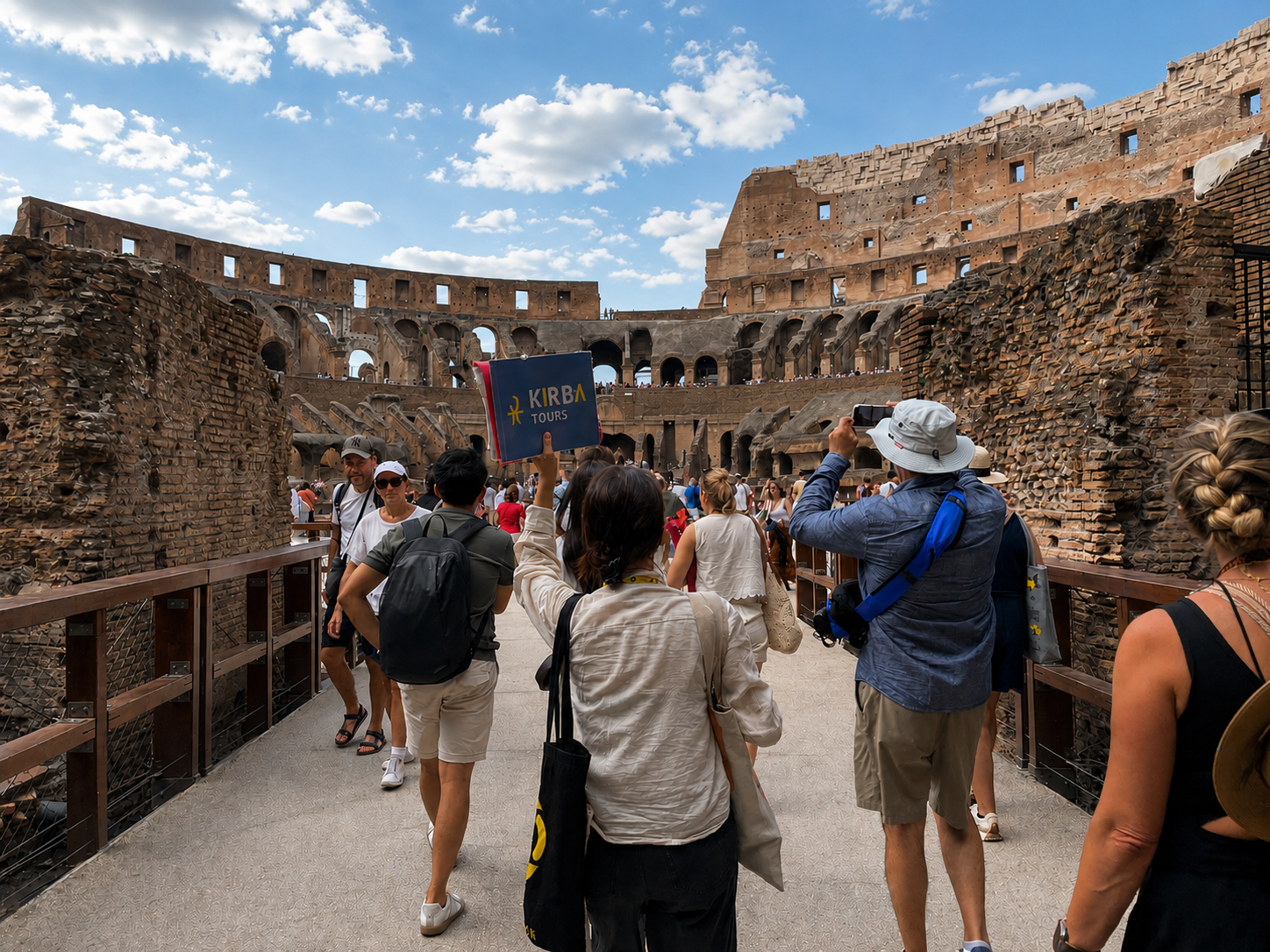
Walking onto the Colosseum Arena Floor is one of the most memorable ways to experience Rome’s most iconic ancient monument. This is the place where gladiators once fought, wild animals appeared from underground passages, and spectacular events entertained thousands of Roman spectators.
Today, visitors can access a restored section of the arena floor with special admission, offering a unique perspective of the amphitheater and a chance to imagine what it was like to stand at the center of the ancient spectacles.
The Colosseum Arena: Where Gladiators Fought
The Colosseum is the largest amphitheater of the ancient Roman world and one of the most famous landmarks in Rome. Construction began under Emperor Vespasian in the 1st century AD and was completed under his successors, Titus and Domitian.
At the heart of the monument was the arena, the central area where the spectacles took place. The original arena floor was made of wood and covered with sand. In fact, the Latin word harena, meaning sand, is the origin of the modern word “arena.”
This was the stage for gladiatorial combats, animal hunts, executions and elaborate public spectacles. Beneath the wooden floor was a complex underground structure that allowed animals, gladiators and scenery to be brought into the arena through a series of passages, lifts and trapdoors.
The Architecture of the Colosseum
The Colosseum was an extraordinary feat of Roman engineering. Its elliptical structure measures approximately 189 meters long and 156 meters wide, while its exterior originally reached around 48–50 meters in height.
The monumental façade featured several levels of arches decorated with the three classical architectural orders: Doric, Ionic and Corinthian. A higher attic level was added above them, with supports for the velarium, a huge retractable canopy designed to provide shade for spectators.
The amphitheater had 80 entrances, allowing enormous crowds to enter and leave the building efficiently. Different entrances and seating areas were used according to social status, with dedicated access for important figures such as the emperor and senators.
The Cavea: Where Roman Spectators Sat
The seating area of the Colosseum was known as the cavea. Spectators were not seated randomly: their places reflected the strict social hierarchy of Roman society.
The seats closest to the arena were reserved for the most important members of society, including the emperor and senators. Other sections accommodated members of the equestrian class and the wider Roman population, with ordinary citizens seated higher up in the amphitheater.
The Colosseum could accommodate tens of thousands of spectators, making it one of the largest entertainment venues of the ancient world.
From the arena floor, visitors today can appreciate just how impressive the view must have been for both the performers and the enormous crowd surrounding them.
Gladiators and Ancient Roman Spectacles
Gladiators were professional fighters who came from different backgrounds. Many were enslaved people or prisoners of war, while others voluntarily entered the profession in search of fame, money or social status.
They trained in specialized gladiatorial schools and fought according to different styles. Some of the best-known gladiator types included the Murmillo, Secutor, Thraex and Retiarius, each traditionally associated with different weapons, armor and fighting techniques.
But gladiatorial combat was only one part of the entertainment held at the Colosseum. The arena also hosted venationes, spectacular animal hunts featuring wild animals brought from different parts of the Roman Empire.
The underground area beneath the arena played an essential role in these shows, allowing animals, scenery and performers to appear suddenly before the audience.
What Was Beneath the Colosseum Arena?
One of the most fascinating features of the Colosseum is the hypogeum, the underground network hidden beneath the arena floor.
It contained corridors, rooms, elevators and mechanisms used to organize the spectacles above. Animals could be kept in cages underground before being raised into the arena, while gladiators and performers could also be moved through the complex.
The hypogeum was largely concealed from spectators, making the sudden appearance of animals and combatants even more dramatic.
Today, parts of this underground structure are visible from different areas of the Colosseum, giving visitors an insight into the sophisticated organization behind the ancient games.
How to Visit the Colosseum Arena Floor Today
Walking onto the Colosseum Arena Floor offers a completely different perspective compared with viewing the monument from the standard visitor areas.
From the center of the amphitheater, you can look up toward the surrounding tiers and imagine the thousands of spectators who once filled the seats. You can also appreciate the scale of the arena and understand how the underground hypogeum was connected to the events taking place above.
Arena access is limited and subject to ticket availability, so booking in advance is highly recommended, particularly during the busiest months.
For the best experience, we recommend visiting the arena with a knowledgeable guide. A guided tour can help bring the site to life, explaining how the games were organized, who the gladiators were and how the impressive mechanisms beneath the arena worked.
Experience the Colosseum Arena with a Gladiator Tour
If you want to explore the Colosseum with special access to the arena floor, our semi-private Colosseum Gladiator Small Group Tour offers a more immersive way to discover this iconic monument.
With Kirba Tours, you can stand on the arena floor where ancient spectacles once took place while learning about gladiators, Roman society, the architecture of the amphitheater and the fascinating world hidden beneath it.
Rather than simply visiting the Colosseum, you’ll have the opportunity to understand the stories and people behind one of the most extraordinary monuments of ancient Rome.
FAQ – Colosseum Arena Floor
Can you walk on the Colosseum Arena Floor?
Yes. Visitors can access a restored section of the Colosseum Arena Floor with a ticket that includes this special access. Availability is limited and may vary depending on the ticket type.
What happened on the Colosseum Arena Floor?
The arena hosted gladiatorial combats, animal hunts, executions and other large-scale public spectacles designed to entertain the Roman population.
Is the Colosseum Arena Floor worth visiting?
Absolutely. The arena floor provides a unique perspective of the Colosseum and allows visitors to experience the amphitheater from the same central area where ancient spectacles took place.
Can you visit the Colosseum Arena Floor without a guide?
Special tickets can provide access to the arena floor, but a guided tour can make the experience much more informative. A guide can explain the gladiatorial games, the Roman social hierarchy, the architecture and the underground mechanisms that made the spectacles possible.
Should you book the Colosseum Arena Floor in advance?
Yes. Arena access is limited, and tickets can sell out, especially during the high season. Booking in advance is strongly recommended if walking onto the arena floor is an important part of your visit.
Ready to Experience the Colosseum with Us?
Want to explore the Colosseum with an expert guide and step onto the historic Arena floor? Join our Colosseum & Gladiator Arena Small-Group Tour , with a maximum of 10 participants. Discover the world of gladiators, ancient Roman spectacles, and the history behind one of Rome’s most iconic landmarks.