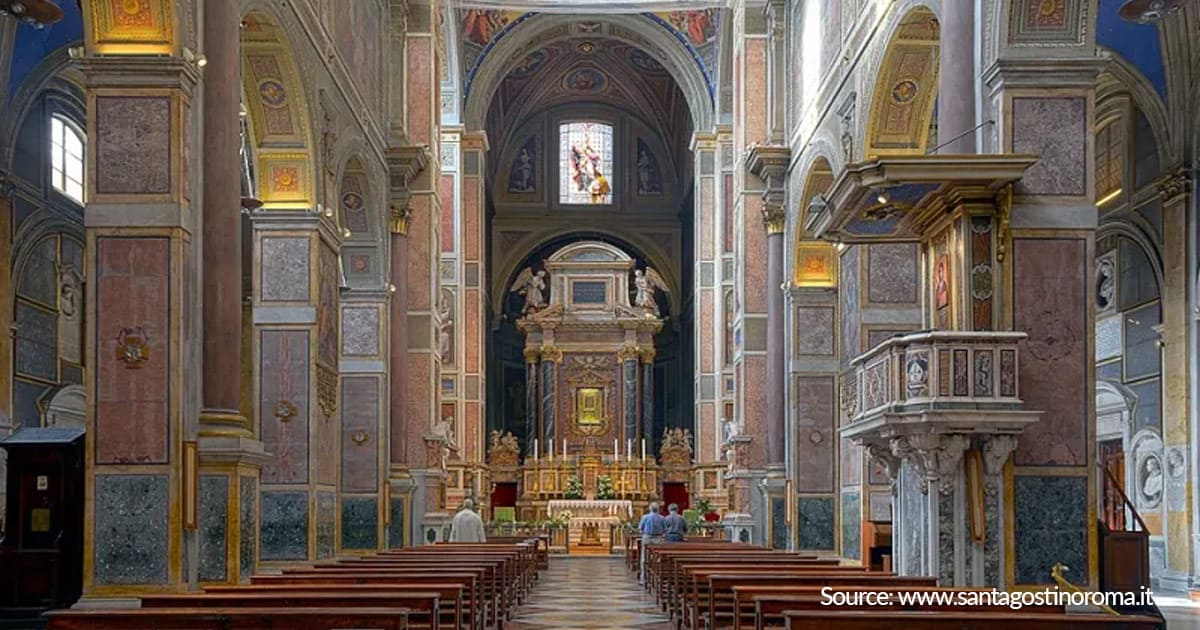
A short walk from the crowds of Piazza Navona, on a quiet square most tourists pass without a second glance, stands one of the great churches of Renaissance Rome. The Basilica of Saint Augustine of Hippo in the Campus Martius, known to Romans simply as Sant’Agostino, hides one of the richest art collections in the city behind a plain travertine facade. Inside are a Caravaggio, a Raphael, sculptures by two members of the Sansovino family, and the tomb of Saint Monica, the mother of Saint Augustine himself. For travelers who want to see a genuine masterpiece without waiting in a two-hour line, this free, working basilica is one of the smartest stops in Rome.
The basilica sits in the heart of a neighborhood layered with history above and below ground. If exploring hidden Rome appeals to you, it pairs perfectly with an underground Rome tour of the Trevi Fountain and Piazza Navona, which descends beneath the streets to the ancient aqueduct chambers of the Vicus Caprarius and the buried Stadium of Domitian, the very foundations that give Piazza Navona its distinctive shape. Seen together, the basilica above and the ruins below tell the full story of how Rome was built, layer upon layer, over two thousand years.
The History of the Basilica of Saint Augustine of Hippo in the Campus Martius
The story of this church begins long before the Renaissance. A much older church stood on or near the site as early as the eighth century, dedicated to Saint Tryphon, a young martyr from Asia Minor. When the Order of Saint Augustine, founded in Rome in 1244, wanted a home closer to the Vatican, a Roman nobleman donated land here in the Campus Martius, and in 1287 Pope Honorius IV granted the friars the old church of Saint Tryphon.
The Augustinians built their first church on the spot in the following decades, but by the late fifteenth century they needed something grander. The building we see today went up between 1479 and 1483, commissioned by Pope Sixtus IV, funded by the wealthy French cardinal Guillaume d’Estouteville, and designed by the architect Baccio Pontelli, who also worked on the Sistine Chapel. It was one of the very first Renaissance churches in Rome.
A Facade Built from the Colosseum
Here is a detail that stops most visitors in their tracks. The facade of Sant’Agostino, completed by Giacomo di Pietrasanta, was built using travertine stone salvaged from the ruins of the Colosseum. For centuries, Rome’s ancient monuments served as quarries for new buildings, and this church wears a piece of the amphitheater on its front. When you stand before it, you are literally looking at the Colosseum, reassembled into a Renaissance church. An inscription across the facade still credits Cardinal d’Estouteville and the year 1483.
Floods, Restorations, and Vanvitelli
Because the Campus Martius sits low beside the Tiber, flooding was a constant threat for centuries before the river was walled in. The church was raised above the surrounding street level for protection, which is why visitors today climb a flight of steps to reach the entrance.
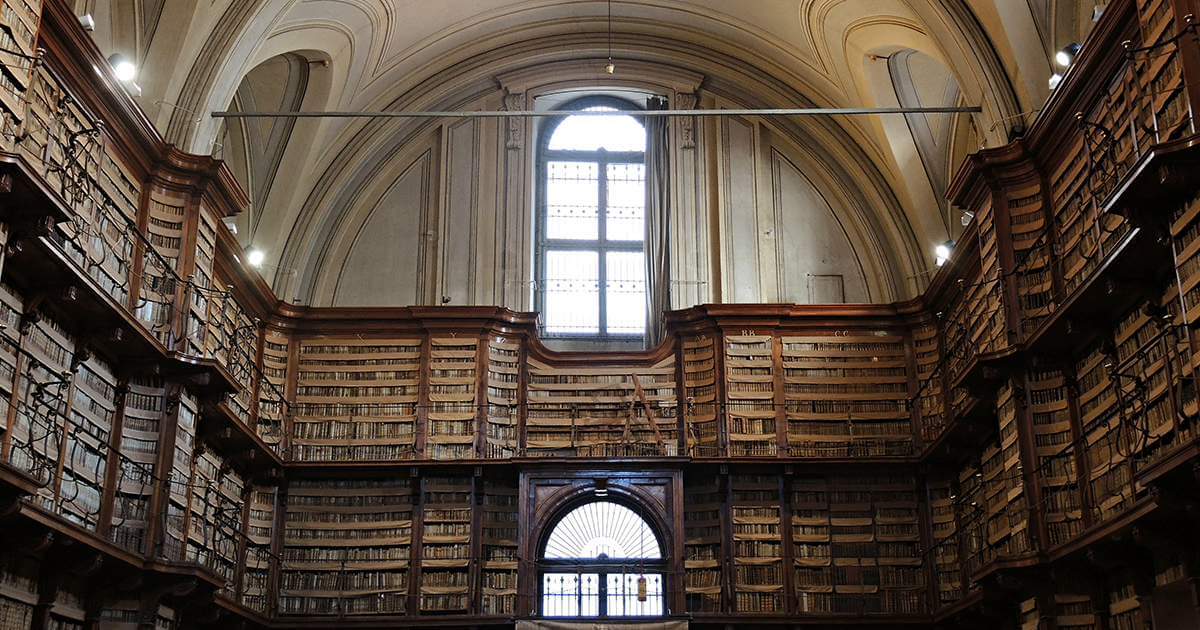
The interior has been reworked several times. The most significant restoration came in the eighteenth century under Luigi Vanvitelli, one of the great architects of the Italian Baroque, who also enlarged the adjoining convent. Further restorations followed in 1870 and again in 1998 to 2000, giving the church its appearance today: a Latin-cross plan with three naves and a series of side chapels packed with art.
Masterpieces Inside Sant’Agostino
The reason art lovers seek out this basilica comes down to a handful of extraordinary works, each with its own story.
Caravaggio’s Madonna of Loreto
In the first chapel on the left hangs the basilica’s most famous treasure: the Madonna of Loreto, also called the Madonna of the Pilgrims, painted by Caravaggio around 1604 to 1606. It was commissioned for the Cavalletti family chapel, and it caused a stir the moment it was unveiled.
Caravaggio painted the Virgin Mary not as a remote, idealized queen of heaven but as a real young woman standing barefoot in a doorway, holding a heavy child. Kneeling before her are two humble pilgrims, their feet dirty from the road, shown with unflinching realism. To modern eyes the painting is tender and deeply human. To some of Caravaggio’s contemporaries, the mud and the plain faces bordered on scandalous. The light that pulls the figures out of the surrounding darkness is pure Caravaggio, and it remains one of the most moving religious paintings of the entire Roman Baroque. Bring a few coins for the light box that illuminates the canvas.
Raphael’s Prophet Isaiah
On the third pillar of the left nave is a fresco of the Prophet Isaiah, painted by Raphael in 1512. Isaiah holds a Hebrew scroll, and the figure shows the powerful, muscular influence of Michelangelo, whose Sistine Chapel ceiling Raphael had recently seen. It was created as part of a funerary monument for a humanist scholar named Johann Goritz. Directly below it sits a marble sculpture of Saint Anne, the Virgin, and Child by Andrea Sansovino, completed the same year, so the two works were designed to be seen together.
The Madonna del Parto
Just to the right of the main entrance stands a sculpture that means more to many Roman worshippers than any painting in the church: the Madonna del Parto, or Our Lady of Childbirth, carved by Jacopo Sansovino in 1521. According to tradition, expectant mothers have prayed here for safe deliveries for centuries. The statue is usually surrounded by flowers, candles, and small silver offerings left in thanks, a living devotional practice you can still witness today. Legend even holds that the sculptor based the composition on an ancient Roman statue.
Guercino, the High Altar, and More
The basilica holds far more than its three headline works. Look for a painting of Saints Augustine, John the Evangelist, and Jerome by Guercino, ceiling frescoes and paintings by Giovanni Lanfranco in the left transept, and a sculpture of Saint Thomas of Villanova giving alms by Melchiorre Cafà. The high altar was designed by Orazio Turriani in 1628, and its rich canopy long led visitors to mistakenly credit Bernini. The nineteenth-century nave ceiling and pillar frescoes are the work of Pietro Gagliardi.
Saint Monica and the Spiritual Heart of the Basilica
For pilgrims, the true center of Sant’Agostino is not a painting but a tomb. Saint Monica, the mother of Saint Augustine, is buried here in a chapel to the left of the apse.
Monica died in 387 in the port town of Ostia, near Rome, as she and her son were preparing to return to North Africa. Augustine, who would become one of the most influential thinkers in the history of Christianity, wrote movingly about her faith and her tears in his Confessions. Her remains were transferred to this basilica in 1424, and her sarcophagus was carved by the sculptor Isaia da Pisa around 1455. For Catholic travelers, especially those who have read Augustine, standing before her tomb is a genuinely powerful moment.
A Living Augustinian Church
Sant’Agostino is not a museum. It serves as the motherhouse of the Order of Saint Augustine worldwide, and the Augustinian friars still care for it, filling its days with Mass, prayer, and confession. In 1999, Pope John Paul II elevated it to the rank of minor basilica, and it serves as the station church for the first Saturday of Lent, part of Rome’s ancient cycle of pilgrimage churches. When you visit, remember that people are here to pray, not only to look.
Social History: Courtesans, Pilgrims, and Caravaggio’s Rome
Every old Roman church carries stories, and Sant’Agostino has more than most. In the sixteenth and seventeenth centuries, its location near the busy heart of the city gave it an unusually varied congregation. The church was historically known as a burial place for some of Rome’s famous courtesans, women who occupied a complicated and often privileged position in Renaissance society, a detail that says a great deal about the tangled relationship between wealth, faith, and reputation in the city at the time.
The basilica also sits squarely in Caravaggio’s Rome. The painter lived and brawled in these very streets around Piazza Navona, and his choice to model sacred figures on ordinary Romans, possibly including people from the neighborhood’s margins, was part of what made his religious paintings feel so radical and, to some, so provocative. Standing in front of the Madonna of Loreto, you are looking at that revolution in real time.
Planning Your Visit
Sant’Agostino is easy to reach, free to enter, and rarely crowded, which makes it one of the best-value stops in central Rome.
Location and Getting There
- Address: Piazza di Sant’Agostino, a few minutes on foot from Piazza Navona and near Via della Scrofa.
- On foot: It is an easy walk from the Pantheon, Piazza Navona, and Castel Sant’Angelo, making it simple to add to a day exploring the historic center.
- By public transport: Numerous buses serve the nearby Corso del Rinascimento and Corso Vittorio Emanuele II. The area is not served directly by the metro, so walking is usually the best option.
Opening Hours and Admission
- Hours: The basilica is generally open Monday through Saturday from about 7:30 a.m. to 12:30 p.m. and 4:00 p.m. to 7:30 p.m., with slightly different Sunday and holiday hours. Times change, so confirm on the official basilica website before you go.
- Admission: Entry is free.
- During Mass: Sightseeing is not permitted during liturgical celebrations, so plan around service times if you want to view the art at leisure.
Mass Times
Masses are typically celebrated on weekdays and Saturdays at 8:00 a.m. and 6:30 p.m., with additional Sunday and holiday Masses in the morning and midday. Confirm the current schedule with the church, as times may be adjusted.
Dress Code and Etiquette
- Dress modestly. As in all Roman churches, cover your shoulders and knees. Bring a light scarf or layer in summer.
- Keep quiet. This is an active place of worship, so lower your voice and silence your phone.
- Photography: Photography without flash is generally tolerated, but never during services, and always follow any posted signs.
How Long to Budget
A focused visit to see the Caravaggio, the Raphael, the Madonna del Parto, and Saint Monica’s tomb takes about 30 to 45 minutes. Combine it with nearby Piazza Navona, the Pantheon, and an underground tour for a rich half day in this corner of the city.
Frequently Asked Questions
Is the Basilica of Sant’Agostino free to visit?
Yes. Entry to the basilica is free of charge. It is an active church rather than a ticketed museum, so you can walk in and see the Caravaggio and other masterpieces at no cost, outside of Mass times.
Which Caravaggio is in Sant’Agostino?
The church holds the Madonna of Loreto, also known as the Madonna of the Pilgrims, painted around 1604 to 1606. It hangs in the first chapel on the left and is one of Caravaggio’s most celebrated religious works.
Where is Saint Monica buried?
Saint Monica, the mother of Saint Augustine, is buried in a dedicated chapel to the left of the main apse. Her relics were brought to the basilica in 1424, and her sarcophagus dates to around 1455.
How far is it from Piazza Navona?
The basilica is only a few minutes’ walk north of Piazza Navona, making it easy to combine with the square, the Pantheon, and other sights in Rome’s historic center.
Why Sant’Agostino Belongs on Your Rome Itinerary
In a city that can overwhelm you with ticketed blockbusters, the Basilica of Saint Augustine of Hippo in the Campus Martius offers something quieter and, in its own way, more rewarding. You can stand alone before a Caravaggio, study a Raphael painted in the shadow of the Sistine Chapel, and pray at the tomb of a saint whose son shaped Western thought, all for free, all in under an hour, all steps from Piazza Navona. It is the kind of place that turns a good trip to Rome into a memorable one. Pair it with a guided walk through the streets and the ancient world beneath them, and let the Eternal City reveal itself the way it rewards those who look a little closer, one masterpiece at a time.