
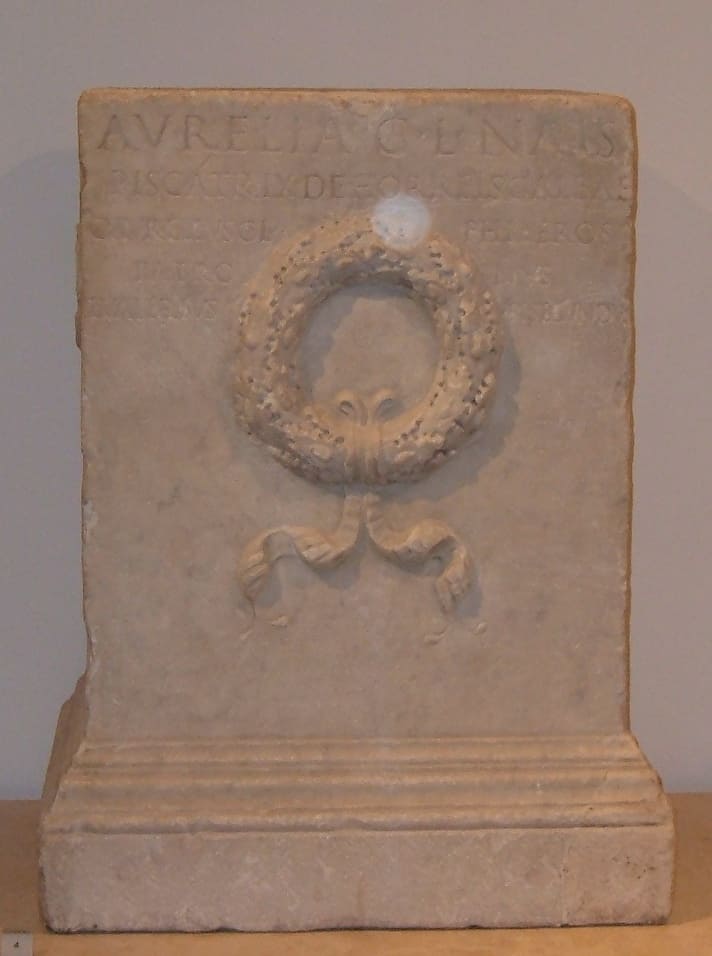
Nearly two thousand years ago, someone paid a stonecutter to carve four short lines of Latin into a marble altar. The letters are crisp, the spacing careful, the wreath above them cut in high relief. And in the second line sits a word that appears nowhere else in the entire surviving body of Latin writing: piscatrix. Fisherwoman. Fish seller. The woman it describes was named Aurelia Nais, she had been born a slave, and she sold fish beside the warehouses of Galba on the Tiber. Almost every other ordinary Roman woman who reached us through stone is remembered as somebody’s wife, mother, or daughter. Aurelia Nais is remembered for her work.
Stories like hers are the reason Rome rewards travelers who go past the headline monuments, and they are almost impossible to find alone. A guide who knows the city can take you from the Colosseum and the Pantheon to the working districts along the river where people like Aurelia actually lived, and can read an inscription aloud in a museum case until it stops being decoration and becomes a person. If you want that kind of depth on your trip, explore our private Rome tours with expert local guides, built around your interests and your pace, whether that means ancient engineering, the lives of ordinary Romans, or a hands-on cooking class in a local kitchen. Tell us what draws you in, and we will shape the day around it.
Who Was Aurelia Nais?
Aurelia Nais was a liberta, a freedwoman, meaning she had been enslaved and then formally released. Her name tells that story on its own. Enslaved people in Rome typically carried a single name, often a Greek one chosen by their owners, and Nais is exactly that kind of name. When she was freed, she took the family name of her former owner, which is how she became Aurelia Nais rather than simply Nais.
The inscription names two other freedmen alongside her. Gaius Aurelius Phileros is identified as her patronus, her patron, which almost certainly means he was the man who granted her freedom. The second, Lucius Valerius Secundus, came from a different household and may have been her husband, though the text does not say so. All three were freed slaves, and all three were Roman citizens.
The altar has three hollows carved into its top, spaces meant to hold cremation urns. It was built to hold all three of them.
A Word That Survives Only Once
The Latin text is short. Rendered into English, it reads roughly: Aurelia Nais, freedwoman of Gaius, fish seller of the warehouses of Galba. Gaius Aurelius Phileros, freedman of Gaius, her patron. Lucius Valerius Secundus, freedman of Lucius.
The remarkable part is that single professional title. Recent scholarship on commercial fishing along the lower Tiber notes that piscatrix is the only occurrence of the feminine form anywhere in Latin epigraphy or literature. Men appear constantly in Roman inscriptions as bakers, shoemakers, cattle dealers, and gladiator trainers. Women almost never do, and when a woman’s trade does surface, it is usually folded into a household role. Aurelia Nais got her occupation carved into the second line of her own monument, directly beneath her name.
The layout reinforces the point. The lines naming Aurelia are cut in larger, better-executed letters than those naming the two men, and the oak wreath on the front of the altar is arranged so that her portion of the text reads uninterrupted. Whoever commissioned this stone wanted her name and her profession to be what a passerby saw first.
The Horrea Galbae: Rome’s Riverfront Warehouse District
The phrase de horreis Galbae anchors Aurelia to a specific place in Rome. The Horrea Galbae were a vast complex of warehouses in the Emporium district, the commercial riverfront between the southeastern slope of the Aventine Hill and Monte Testaccio, the artificial mountain built entirely from discarded amphorae.
The warehouses were originally built by the Sulpicii family in the second century BC and later passed into imperial hands, taking the name of the emperor Galba. They held enormous quantities of goods arriving up the Tiber from Ostia and the wider Mediterranean, principally olive oil and wine.
What She Actually Did There
Historians have debated what a fish seller was doing among oil and wine warehouses. One reading holds that the inward-facing units shown on the ancient marble plan of Rome could have worked something like a macellum, a covered market, with customers entering shops from the interior courtyards. Another suggests the Horrea simply gave her somewhere to store fishing equipment.
The market interpretation fits better with what the stone itself implies. The fact that the inscription ties her to a fixed location suggests she was established there over a long period rather than working as a traveling vendor. It is even possible she operated at a wholesale level, supplying fishmongers across the city from her spot at the Horrea, which would help explain how she came to afford a finely carved marble monument at all.
When Did She Live?
This is worth flagging, because sources disagree. Some popular accounts place the monument in the second or third century AD. Specialist study of the lettering points earlier. The inscription uses apex marks above certain vowels, a feature common in Roman epigraphy of the second half of the first century AD, and recent archaeological work on Tiber fishing dates the monument to the late first century AD.
That earlier dating also makes better sense of the text itself. Galba reigned only in AD 68 to 69, and the warehouses took his name when they became imperial property. A woman working there and describing them as the warehouses of Galba fits most naturally into the decades immediately following.
From the Horrea to Testaccio Market
Here is the detail that gives the whole story its charge. The monument was found in the area of Rome that is now Testaccio, a few minutes’ walk from the modern Testaccio Market, which is still lined with fishmongers calling out prices over ice-packed counters every morning.
Roughly twenty centuries separate Aurelia Nais from the woman selling sea bass in Testaccio today, and they were working within the same few hundred meters, in the same trade, in the same neighborhood. Very few cities on earth can offer that kind of continuity, and it is the sort of thing Rome hands you almost casually if you know where to look.
Where to See Aurelia Nais Today
The funerary altar of Aurelia Nais is on display at the National Roman Museum, Baths of Diocletian, as part of the museum’s section on written communication in the Roman world. The National Roman Museum holds one of the largest epigraphic collections anywhere, with roughly twenty thousand inscriptions, and this section is where the lives of ordinary Romans come through most clearly.
Her altar sits among other monuments to Roman working life, including a memorial to a shoemaker and an altar raised for a cattle dealer. Seen together, they form a portrait of the city’s working population that no marble emperor can give you.
Visiting Information
- Address: National Roman Museum, Baths of Diocletian, Viale Enrico de Nicola 78, 00185 Rome
- Hours: Tuesday to Sunday, 9:00 to 19:00. Last admission at 18:00. Closed Mondays.
- Free admission: The first Sunday of every month is free at all Italian state cultural sites.
- Getting there: The Baths of Diocletian sit directly opposite Termini Station, making this one of the easiest museums in Rome to reach.
Special Openings Still Ahead in 2026
- Saturday, September 26: European Heritage Days, with an evening opening priced at 1 euro
- November 1: free admission
- November 4: free admission
- December 7 and 8: special openings
Schedules can change, so confirm on the museum’s official site before you go.
A Name That Outlasted an Empire
The Roman Empire produced emperors, generals, and poets whose names we still recite. It also produced millions of people who worked, ate, argued, and died without leaving a trace. Aurelia Nais should have been one of them. Instead, a patron and a companion spent real money on marble, and a stonecutter carved a word that no other Latin text preserves, and because of that a freedwoman who sold fish on a riverbank in the first century is still here.
That is the Rome worth traveling for: not only the monuments built to impress, but the small stones that preserve a life. Walk the city with someone who can find them for you, and the Eternal City stops being a list of ruins and starts being a record of everyone who lived in it.
By Kleuske – Own work, CC BY-SA 3.0, Link