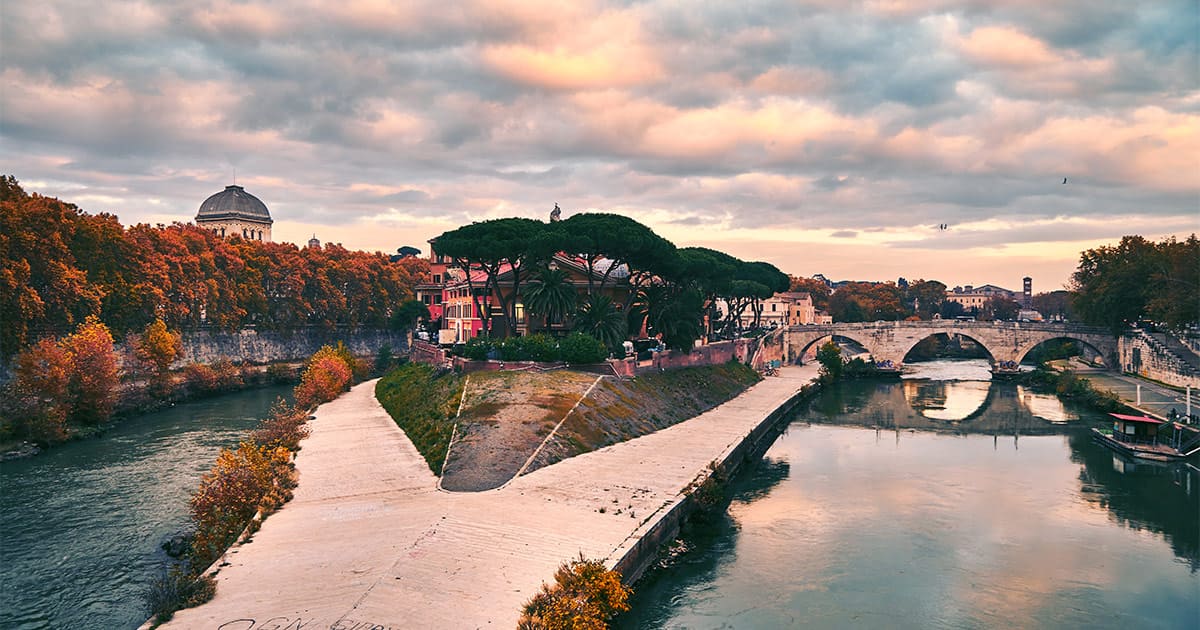
Floating serenely in the Tiber River, Tiber Island—Isola Tiberina—is one of Rome’s most unique landmarks. Shaped like a ship and steeped in legend, this small island has been linked to medicine and healing since antiquity. From its ancient temple dedicated to Aesculapius, the god of medicine, to the modern Fatebenefratelli Hospital, it has long been considered the city’s healing heart. Today, exploring the island on a Tiber Island tour with a private guide allows you to uncover centuries of fascinating history while enjoying a comfortable golf cart tour in Rome.
A Legendary origin story
According to ancient tradition, Tiber Island was formed after the fall of Rome’s last king, Tarquinius Superbus, in 510 BC. Angry Romans are said to have thrown their grain stores into the river, where silt and debris accumulated around them until the island emerged. Another version claims that Tarquinius’s body itself was thrown into the Tiber, and over time, the river embraced it, creating the island. Whatever its true geological origins, the site soon became central to Rome’s mythology and identity.
The Temple of Aesculapius and healing traditions
In 293 BC, when a devastating plague struck Rome, the Senate consulted the Sibylline Books for guidance. Priests were instructed to send a delegation to Epidaurus in Greece to retrieve a statue of Asclepius, the god of medicine. Legend recounts that the delegation returned not with a statue, but with a sacred snake. As the ship sailed up the Tiber, the serpent slithered onto Tiber Island, a sign that the god had chosen the location himself.
A temple was built where the snake landed, transforming the island into a sacred place of healing. To commemorate the legend, the island was even shaped to resemble a ship, with travertine stonework resembling a prow and stern. At its center, an obelisk stood as the mast, symbolizing divine protection over Rome’s health.
From Ancient Temple to Medieval Basilica
Over the centuries, Tiber Island retained its association with healing. In the 10th century, Emperor Otto III built the Basilica of San Bartolomeo all’Isola on the ruins of the temple of Aesculapius. Dedicated to the martyrs St. Adalbert of Prague and St. Bartholomew, the basilica remains a site of worship and reflection. Today, visitors can still admire its medieval architecture and feel the spiritual continuity of a site that has been sacred for over two millennia.
The Fatebenefratelli Hospital
In 1584, the Hospitaller Order of St. John of God established the Fatebenefratelli Hospital on the island. Still active today, it continues the island’s ancient mission of healing. During World War II, the hospital became a sanctuary when its director, Dr. Giovanni Borromeo, created a fictitious disease known as “Il Morbo di K.” The fake diagnosis deterred Nazi soldiers from entering the wards, saving the lives of countless Jews hiding there. This act of courage further cemented Tiber Island’s reputation as a place of compassion and healing.
Bridges of Connection
Since ancient times, Tiber Island has been connected to the city by two historic bridges. The Ponte Fabricio, built in 62 BC, is the oldest surviving bridge in Rome still in its original form. It connects the island to the left bank and the ancient Campus Martius. On the other side, the Ponte Cestio connects the island to Trastevere, one of Rome’s most vibrant neighborhoods. Walking across these bridges today, visitors follow in the footsteps of centuries of Romans who crossed here in search of healing and hope.
Festivals and Modern Culture
Even today, the island remains a center of cultural life. Every summer, Tiber Island hosts the “Isola del Cinema,” a popular film festival that brings locals and tourists together under the stars. Its cinematic setting, framed by the waters of the Tiber, makes it one of the most atmospheric cultural events in Rome. The island has also appeared in popular culture, from the writings of Ovid to video games like Assassin’s Creed: Brotherhood.
Why Visit Tiber Island with a Golf Cart Tour?
Exploring Tiber Island on foot is possible, but combining it with a golf cart tour of Rome offers unparalleled convenience and storytelling. A private guide ensures you learn the island’s legends, uncover hidden details, and seamlessly connect your visit with nearby landmarks like Trastevere, the Jewish Ghetto, and the Capitoline Hill. For history lovers, wellness seekers, and curious travelers, it is an experience that blends comfort with discovery.
A Unique Island Experience
With its unique boat-like shape, layered history, and reputation as a place of healing, Tiber Island is far more than just a geographical curiosity. It embodies the resilience of Rome itself—transforming myth into memory, plague into healing, and faith into compassion. Whether you’re drawn to its ancient legends, its medical heritage, or simply its quiet beauty, the island deserves a place on your Roman itinerary.
Book Your Tiber Island Tour
Ready to uncover the secrets of Rome’s only river island? Book your Tiber Island tour with a private guide and enjoy the convenience of an eco-friendly golf cart. With Kirba Tours, you’ll experience one of Rome’s most fascinating and peaceful sites while discovering the Eternal City’s hidden gems. Book now at kirbatours.com and step into Rome’s healing heart.
By Deensel – Isola Tiberina, Rome, CC BY 2.0, Link