
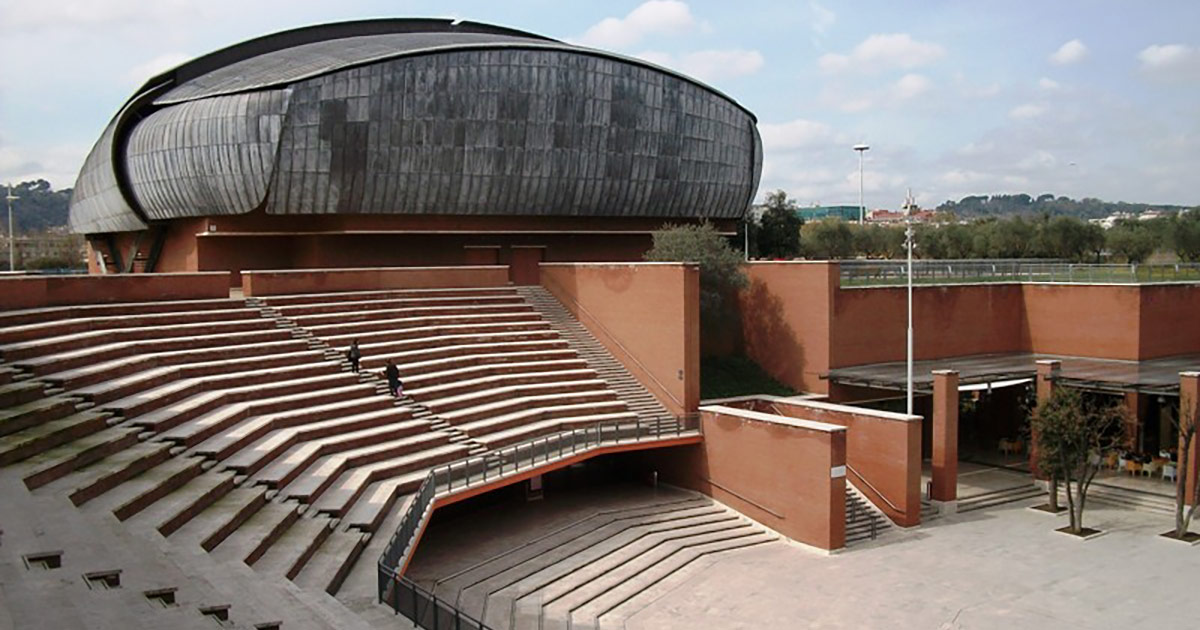
In the Flaminio neighborhood, north of Rome’s historic center, three enormous lead clad shells sit in a park like enormous beetles that landed and never left. This is the Auditorium Parco della Musica Ennio Morricone, designed by Renzo Piano and opened in 2002, one of the busiest cultural complexes in Europe. Almost nobody who comes here for a concert realizes what is directly under their feet. When the bulldozers arrived in the 1990s, they hit something far older than any concert hall: the remains of a farmhouse first built in the middle of the sixth century BC, followed by a patrician villa that stood on the same ground for the better part of eight hundred years. Rather than bury it again, Piano redesigned his building around it.
The name of the district is itself a piece of ancient history. Flaminio takes its name from the Via Flaminia, the consular road that has run north out of Rome since 220 BC, and that road begins at Piazza del Popolo. We covered that square and its Egyptian centerpiece in our guide to Piazza del Popolo and the Flaminio Obelisk, a three thousand year old monument brought to Rome by Augustus. Walk north from that obelisk, follow the same route Roman legions and medieval pilgrims once took, and you arrive at the Auditorium. The connection is not a coincidence. This whole area has been the road out of Rome for well over two thousand years, which is precisely why a wealthy Roman family built a working estate here.
A Concert Hall Rome Waited Sixty Years For
To understand why the Auditorium ended up in Flaminio at all, you have to go back to 1936. The Accademia Nazionale di Santa Cecilia, one of the oldest musical institutions in the world, had performed since 1908 in a superb concert hall known as the Augusteo. That hall was built into the ruins of the Mausoleum of Augustus, and in 1936 Mussolini ordered it destroyed so the ancient imperial tomb could be brought back to light.
Rome’s greatest orchestra was left without a home. For decades it rented spaces around the city while administrators debated where to build a replacement, and figures such as the conductor Giuseppe Sinopoli campaigned to give music a permanent address in the capital.
In 1993 the City of Rome finally launched an international competition, naming a neglected stretch of land between the 1960 Olympic Village and Pier Luigi Nervi’s Flaminio Stadium as the site. On July 27, 1994, the Renzo Piano Building Workshop was declared the winner, and in January 1995 the project was formally handed over. There is a pleasing symmetry in the story: an orchestra evicted by archaeology in 1936 was about to be interrupted by archaeology all over again.
The Discovery That Halted Construction
In 1995, during preliminary earthmoving, workers uncovered substantial wall remains. Construction stopped. Between 1996 and 1998 archaeologists carried out a complete excavation of the area and uncovered a complex covering more than 2,000 square meters, with material spanning from the middle of the sixth century BC to the early third century AD.
From Archaic Farmhouse to Patrician Villa
The oldest structure was a rustic farmhouse of the Archaic period, probably the home of a prosperous farmer who was also a Roman citizen and a soldier. It was demolished around 500 BC, and on its remains a large patrician villa was built, complete with a walled village that likely housed the farm workers. That phase runs roughly from 500 to 300 BC.
At least three further building phases significantly reshaped the villa over the following centuries, turning it into an atrium style house. It was finally abandoned in the opening decades of the third century AD. What the excavation produced is essentially a domestic archive: eight hundred years of one piece of Roman countryside, recorded layer by layer in different tuffs.
A Link to the Sanctuary of Anna Perenna
There is an intriguing hypothesis about the site. Archaeologists have suggested the building may have been annexed to the sanctuary of Anna Perenna, the nymph the Romans honored on March 15, the date of the oldest Roman New Year. The suggestion comes from recent research that identified the nymph’s fountain and sacred wood near Piazza Euclide, not far from the Auditorium. If the connection holds, this was not simply a farm but ground with a sacred dimension.
How Renzo Piano Redesigned Around the Ruins
Finding ancient remains under a Roman building site is routine. What happened next was not. Piano adjusted his scheme, widening the space between the halls so the excavation could be displayed permanently in the open air, and added a small archaeological museum to hold the finds. The decision delayed completion by about a year.
The result is one of the most striking juxtapositions in modern Rome. Three twenty first century concert halls, nicknamed the beetles and the turtles for their curved lead roofs, stand around an open archaeological site where a farmer once pressed olives. You walk from a foyer built for acoustic perfection straight out onto stone floors laid before the Roman Republic had finished forming.
Inside the Archaeological Museum
The museum occupies two rooms and is designed to make the site legible rather than simply display objects behind glass.
- Wooden models illustrate the architecture of the farmhouse and the villa through its successive phases, so you can see how the building grew.
- Pottery from the kitchen, the table, and religious use, recovered from the various layers.
- Reconstructed contexts including a kitchen pantry, a bread oven, and an oil press, which together document how food was produced and stored on the estate.
- Terracotta roof tiles, including the large corner gutter tile bearing the head of a river deity, identified as the bearded god Achelous, son of Oceanus. That tile has become the symbol of the museum.
The oil press is the detail that tends to stay with visitors. It is a working piece of agricultural machinery from a countryside estate, sitting quietly beneath a building where the Santa Cecilia orchestra performs Mahler.
The Halls Above the Ruins
The complex is organized as three separate buildings arranged around an open central space, each conceived as a resonating instrument and structurally isolated from the others for acoustic reasons.
- Sala Santa Cecilia, the largest, seats 2,744 and is the home of the Accademia Nazionale di Santa Cecilia orchestra and chorus.
- Sala Sinopoli, named for the conductor who fought for the project, seats around 1,200.
- Sala Petrassi, the most flexible of the three, seats around 700.
- The Cavea, an open air amphitheater in the middle of the complex, holds roughly 3,000 spectators and deliberately recalls ancient Greek and Roman performance spaces.
Sala Petrassi was inaugurated on April 21, 2002, Rome’s traditional birthday, and Sala Sinopoli followed on December 21 of the same year. The complex was fully operational by early 2003. After the death of Ennio Morricone in 2020, the Auditorium was named in his honor.
See the Rest of Rome with an Expert Local Guide
The Auditorium shows what Rome does better than any other city: it builds the present directly on top of the past and leaves both visible. That layering is everywhere once you know how to look for it, and it is exactly what a good guide is for. Discover the best of the city with our private Rome tours and unique experiences, led by expert local guides on walking routes that connect the famous landmarks with the quieter corners most visitors never reach. Step inside the Colosseum and hear the real stories behind the gladiator games. Stand under the open oculus of the Pantheon and watch the light move across the marble. Walk the historic center past Piazza Navona, the Trevi Fountain, and the Spanish Steps while your guide explains what you are actually looking at. If you want something more hands on, add a gladiator training session or an authentic Italian cooking class with a local cook. The tours work equally well for couples, families, and groups of friends, and because they are private, the route and the pace follow your interests rather than a fixed schedule.
Planning Your Visit
- Address: Viale Pietro de Coubertin 30, 00196 Rome, in the Flaminio district.
- Getting there: Take Metro Line A to Flaminio, then tram 2 north to the Apollodoro stop, a short walk from the entrance. Several bus lines also serve the complex.
- Opening hours: The Auditorium is generally open daily from late morning until 8:00 pm, with slightly different summer and winter schedules. On days when a show is staged in the Cavea, the complex closes at 4:00 pm.
- Guided architectural tours of the complex are offered on weekends, including in English.
- Before you go: Hours, museum access, and tour schedules change with the concert calendar, so confirm current details on the official Auditorium website.
- Tickets for concerts are sold separately from access to the public areas and the archaeological museum.
Why This Site Deserves an Hour of Your Trip
The Auditorium is not on most first time itineraries, and it does not need to be. But if you have four or five days in Rome, or if you are returning to a city you already know, an hour in Flaminio pays you back. You get a major work by one of the most important living architects, a free look at an excavation that rewrote the early history of this stretch of the Tiber valley, and a small museum where a bread oven and an olive press sit under a concert hall.
Start at the Flaminio Obelisk in Piazza del Popolo, follow the line of the ancient Via Flaminia north, and finish standing on a farmhouse floor laid two and a half millennia ago. Walk that route with a guide who can read the layers for you, and Rome stops being a list of monuments and becomes one continuous story that has never stopped being written.
Di Mac9 – Opera propria, CC BY-SA 3.0, Collegamento


