Rome is often associated with legendary architects such as Bernini, Borromini, and Pietro da Cortona. Yet hidden behind the masterpieces of the Eternal City is the remarkable story of a woman who broke barriers in a profession dominated entirely by men.
Her name was Plautilla Bricci (1616–after 1690), and she is widely recognized as the first professional female architect in pre-industrial Europe. A gifted painter, designer, and architect, Plautilla earned the unprecedented title of “architettrice”—a word created specifically to acknowledge her role in an era when women were almost entirely excluded from architectural practice. Her life represents a true “silent revolution,” challenging conventions centuries before women could officially study architecture.
Who Was Plautilla Bricci?
Born in Rome in 1616, Plautilla grew up in a highly creative household. Her father, Giovanni Bricci, was much more than a painter: he was also a musician, playwright, poet, and actor. Working in his workshop, Plautilla learned drawing, painting, and artistic techniques from an early age, gaining an education that was exceptionally rare for women of the seventeenth century.
While many women artists of the Baroque period were confined to convents or noble families, Plautilla entered the vibrant artistic world of Rome, developing her skills among painters influenced by the circle of Cavalier d’Arpino, one of the city’s leading artists.
Becoming the First Female Architect
Painting was only the beginning.
Plautilla’s extraordinary talent soon attracted the attention of Abbot Elpidio Benedetti, an influential intellectual and diplomat connected to Cardinal Mazarin, Louis XIV of France, and some of the greatest artists of the Baroque era.
Benedetti became her most important patron, giving her opportunities that almost no woman of her time could have imagined. Under his protection, Plautilla designed decorative projects, altarpieces, and eventually entire architectural works. This collaboration transformed her career from painter to architect—an achievement so unusual that official documents described her with the newly coined title “architettrice.”
A Silent Revolution in Baroque Rome
Seventeenth-century Rome was one of Europe’s artistic capitals, but architecture remained an exclusively male profession.
Plautilla succeeded not by openly challenging society but through talent, perseverance, and exceptional technical ability.
This is why the exhibition dedicated to her at Rome’s Galleria Corsini was appropriately titled “A Silent Revolution.” Rather than leading political movements, Plautilla quietly transformed expectations through her work, demonstrating that artistic excellence knew no gender.
Villa Benedetta: “Il Vascello”
Plautilla’s greatest architectural masterpiece was Villa Benedetta, better known as Il Vascello.
Commissioned by Elpidio Benedetti between 1662 and 1663, the villa stood just outside Porta San Pancrazio on the Janiculum Hill.
Its nickname, Il Vascello (“The Ship”), came from its extraordinary design, whose flowing façades resembled the shape of a sailing vessel. The project represented one of the boldest examples of Roman Baroque architecture.
Although artists such as Bernini and Pietro da Cortona contributed to aspects of the project, historical research confirms that Plautilla directed the construction site herself—an astonishing responsibility for a woman in the seventeenth century.
Sadly, Villa Benedetta was almost completely destroyed during the French siege of Rome in 1849, leaving only fragments that survive today.
More Than an Architect: A Talented Painter
Before becoming famous as an architect, Plautilla had already established herself as a respected painter.
Among her earliest known works is the Madonna and Child created around 1640 for Santa Maria in Montesanto. According to contemporary accounts preserved on the back of the painting, the work was associated with a miraculous event, helping to establish her reputation as a devout and talented young artist.
Over the following decades, she produced numerous religious paintings, altarpieces, banners, and decorative works for churches and religious institutions throughout Rome and Lazio.
Her paintings reveal the dramatic light, emotional intensity, and rich colors characteristic of the Roman Baroque.
Designing Churches in Rome
Plautilla’s architectural achievements extended beyond private residences.
One of her most important surviving projects is the Chapel of Saint Louis inside the Church of San Luigi dei Francesi, designed for Abbot Benedetti.
This remarkable commission placed her alongside some of the greatest architects working in Rome during the seventeenth century, proving that her abilities were recognized by influential patrons despite the limitations imposed on women.
Rediscovering Plautilla Bricci
For centuries, Plautilla Bricci’s achievements remained largely forgotten.
Only in recent decades have historians uncovered new documents, identified additional artworks, and restored architectural drawings preserved in the State Archives of Rome. These discoveries have significantly expanded our understanding of her career and confirmed her importance within Baroque art and architecture.
Her rediscovery reached a wider audience thanks to new scholarly research, exhibitions, and literary works that finally restored her place in the history of European art.
Why Plautilla Bricci Matters Today
Plautilla’s importance extends far beyond architecture.
She represents resilience, creativity, and determination in a society that offered women few professional opportunities.
Long before women could enroll in architecture schools or establish independent practices, Plautilla directed major construction projects, negotiated with influential patrons, and left an artistic legacy that continues to inspire historians, architects, and visitors alike.
Today, she is increasingly recognized as one of the pioneers of women in architecture—not only in Italy but throughout Europe.
Places Connected to Plautilla Bricci in Rome
Visitors interested in discovering Plautilla’s story can explore several locations associated with her life and career:
Galleria Corsini
The museum that hosted the first monographic exhibition dedicated to Plautilla Bricci remains one of the best places to learn about her artistic achievements.
San Luigi dei Francesi
Home to the chapel she designed for Elpidio Benedetti, this famous church also houses Caravaggio’s celebrated paintings, making it an essential stop for lovers of Baroque art.
Janiculum Hill
Although Villa Benedetta no longer exists, walking through the Janiculum area offers insight into the landscape where Plautilla’s most ambitious architectural project once stood.
Santa Maria in Montesanto
One of the churches connected with her earliest artistic career, where her youthful talent first gained recognition.
Why Every Art Lover Should Know Plautilla Bricci
For centuries, the history of architecture was told almost exclusively through the achievements of men.
Plautilla Bricci reminds us that exceptional talent often survived despite extraordinary obstacles.
Her paintings, architectural designs, and determination transformed her into a unique figure within Baroque Rome. Today, she is celebrated not simply because she was the first woman architect, but because her work stands on its own artistic merit.
Her story enriches our understanding of Rome—not only as a city of emperors, popes, and famous male artists, but also as the home of a woman whose quiet determination reshaped the history of architecture.
Frequently Asked Questions
Who was Plautilla Bricci?
Plautilla Bricci (1616–after 1690) was a Roman painter and architect, widely regarded as the first professional female architect in pre-industrial Europe.
Why is Plautilla Bricci famous?
She is famous for becoming the first woman officially recognized as an architect in seventeenth-century Rome and for designing the remarkable Villa Benedetta, known as Il Vascello.
What is the meaning of “architettrice”?
“Architettrice” was a term created in the seventeenth century to describe Plautilla Bricci’s professional role as a female architect, since no equivalent word previously existed.
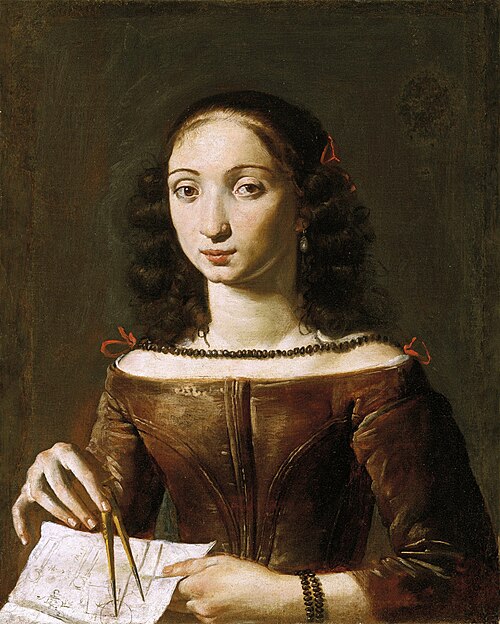
Cover image: Portrait of a Female Architect, probably Plautilla Bricci. Painting by an unknown artist, 17th century, private collection, Los Angeles.