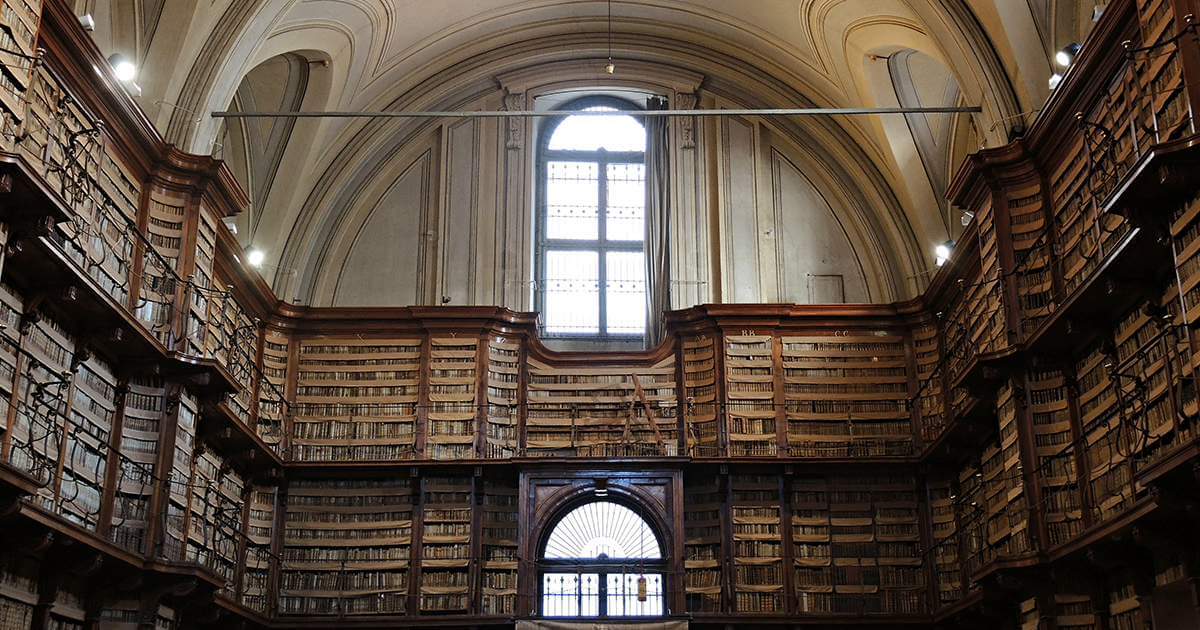
A few steps from Piazza Navona, behind the Church of Sant’Agostino, a plain doorway opens onto one of the most remarkable interiors in Rome. The Augustinian bishop Angelo Rocca founded the Biblioteca Angelica in 1604, wanting a library open to everyone regardless of rank or income, and it has served readers ever since. Upstairs, the Vanvitelli Hall rises two stories in carved walnut shelving under a barrel vault, lined with the books of cardinals and scholars who died three centuries ago. Entry is free. And because this is a working research library rather than a museum, visiting it properly takes a little more planning than most Roman sights.
The library closes at 1:30 p.m. on weekdays, which makes a morning visit here pair naturally with an afternoon elsewhere in the same few streets. The Pantheon is a short walk away, and the Pantheon private tour with fast track entry meets at Piazza Capranica, barely five minutes from the library door. It is a one-hour private visit with an official guide who takes you past the entry line and explains the dome, the oculus, and the tombs inside, and it works well as the second half of a morning that begins with Angelo Rocca’s shelves. Two buildings, two thousand years apart, both still doing exactly what they were built to do.
Before You Go: What to Verify
Information verified on October 19, 2026. Opening days, access conditions, service availability, and tour schedules at the Angelica change, sometimes with short notice. Everything practical below should be rechecked against the library’s own notices before you travel. The library itself advises visitors to consult its website for changes to opening days and times.
Three things in particular are worth confirming, because they are governed by separate rules:
- Entering the building and looking at the Vanvitelli Hall.
- Consulting or borrowing a specific book, which requires an advance request.
- Joining a guided tour or group visit, which is arranged separately.
Opening Hours and Access
As of the date above, the Angelica is open Monday through Friday, 9:00 a.m. to 1:30 p.m., and closed Saturday and Sunday. Distribution and lending services operate within the same window. There is no afternoon or evening opening on ordinary days.
Admission is free. Bring a valid photo ID, since library entry in Italian state institutions generally requires one, and confirm the current age and identification rules if you are visiting with teenagers.
Reservations for Books: An Important Change
This is the detail most travel pages get wrong. During summer 2026, from July 6 to September 5, the library required that consultation and lending be arranged exclusively by email reservation. A later notice published on September 3, 2026, titled new access arrangements, restated the reservation requirement for consulting and borrowing volumes through the same address, b-ange.distribuzione@cultura.gov.it.
In other words, the reservation rule did not simply expire with the summer. If you intend to handle a specific book, write ahead. Under the summer arrangement, requests had to arrive by 12:00 noon on the previous day, excluding Saturdays, Sundays, and public holidays. Check the current notice for the deadline in force when you plan to visit rather than assuming that cutoff still applies.
Your Pre-Visit Checklist
- Date and day. Confirm the library is open and that no closure notice covers your date.
- Purpose. Decide whether you are sightseeing, consulting a book, or joining a tour. The requirements differ.
- Reservation. If you want a specific volume, send the request by email and wait for confirmation before traveling.
- Identification. Carry a valid ID or passport.
- Access needs. Contact the library in advance if anyone in your group needs specific arrangements.
- Contacts saved. Keep the switchboard number and email on your phone in case anything changes on the day.
Where It Is and How to Arrive
The address is Piazza di Sant’Agostino 8, 00186 Rome. The switchboard is +39 06 6840801, answered Monday to Friday from 9:00 a.m. to 1:30 p.m., and the general email address is b-ange@cultura.gov.it.
Finding the Library Near Piazza Navona
The library occupies part of the former Augustinian convent attached to the Church of Sant’Agostino, which is where it has been since Rocca’s day. From the northern end of Piazza Navona, it is a three- or four-minute walk. From the Pantheon, allow about five. The square itself is quiet and easy to miss, which is part of the appeal.
There is no metro station nearby, and the historic center here is a restricted traffic zone, so walking is almost always the sensible option. Several bus lines serve Corso del Rinascimento and Corso Vittorio Emanuele II a short distance away, but routes change, so use a current journey planner on the day rather than relying on line numbers published in articles.
Accessibility: Confirm Before You Travel
Visitor listings describe the library as accessible, and a secondary entrance for people with reduced mobility has been reported at Via Sant’Agostino 13, with advance booking by telephone. Treat that as a starting point for a conversation rather than a guarantee.
Call ahead and ask the specific questions that matter for your visit: whether the entrance you intend to use is step free, whether a lift serves the Vanvitelli Hall on the upper floor, whether assistance needs to be arranged in advance, and whether accessible facilities are available. A general accessibility label on a tourism page does not answer any of those.
Three Ways to Use the Angelica
Travel articles tend to blur sightseeing, reading room access, consultation, and lending into a single experience. They are not the same thing, and knowing which one you want saves a wasted morning.
- A heritage visit. For travelers who want to see the Vanvitelli Hall. Free, during opening hours. Visitors are expected to stay near the hall entrance and not disturb readers at work. No reservation is required, but confirm the current arrangement.
- A guided tour. For groups and for visitors who want an explained visit. Requires advance arrangement with the library. See the tour section below.
- Book consultation. For students, researchers, and anyone wanting to see a specific item. Requires an emailed reservation in advance.
- Borrowing. Listed among the library’s services, with eligibility and conditions to be confirmed directly. Do not assume that rare or historical items can be taken out; those are consulted on site.
- Interlibrary loan. A separate service. It was announced as temporarily suspended on July 1, 2026. Check the current status before building a plan around it.
How to Reserve and Consult a Book
- Search the online catalog first. Identify the item and record its exact title, author, and any catalog or shelf identifier shown.
- Read the current access notice on the library website to confirm the request channel and the deadline in force.
- Send your request by email to the distribution address, including the item details and your intended date.
- Wait for confirmation. A catalog record proves the library holds an item. It does not prove the item is available on a given day.
- Confirm access conditions for the date itself, then travel.
Prepare a shortlist rather than a single title. If one item is unavailable, you still have a productive morning.
Guided Tours of the Vanvitelli Hall
The library’s educational office arranges group guided visits by appointment, and guided tours are reported as free with reservation required. Educational sessions for groups, reported with a maximum of around twenty people, are organized on request and built around the library’s holdings.
A Tuesday tour of the Monumental Hall at 3:00 p.m. was announced to begin in October. Treat that as an announced schedule rather than a permanent weekly fixture, and confirm the current season, date, booking route, and availability directly with the library before counting on it. Note also that an afternoon tour falls outside the ordinary 9:00 a.m. to 1:30 p.m. opening, which is another reason to confirm rather than simply turn up.
One further distinction worth stating plainly: a tour booking is not a book reservation, and neither one is a general entitlement to wander the building.
What the Vanvitelli Hall Looks Like
Luigi Vanvitelli, the architect best known for the royal palace at Caserta, completed the monumental hall in 1765. It has a rectangular plan under a barrel vault, with the wooden shelving attributed to Nicola Fagioli rising in two tiers around the room and a gallery running above. Its proportions earned it the nickname of Vanvitelli’s vase.
Francesco Borromini had worked on the library in the seventeenth century, and Carlo Murena was also involved in the eighteenth century project, but the library records that nothing survives of the earlier Borromini scheme. What you see is Vanvitelli’s room, still in use, still full of the books it was built to hold.
History: 1604 and the Dates That Follow
Accounts of the Angelica cite several different founding dates, which confuses readers. They describe different milestones.
1604, 1609 and 1614
- 1604. The library is established. Angelo Rocca, bishop, scholar, and head of the Vatican Printing Press under Sixtus V, had entrusted his collection of roughly 20,000 volumes to the convent of Sant’Agostino in the closing years of the sixteenth century. He gave the new institution a proper home, its own revenues, its own regulations, and stipulated that it be open to all, without limits of rank or wealth.
- 1609. Commonly cited as the beginning of public access.
- October 23, 1614. The date of a formal act establishing public access, and the year the collection was joined with the convent library.
On the question of whether this is the oldest public library in Europe, it is worth being precise. The library describes itself that way. The Ministry of Culture calls it the oldest public library in Rome and, alongside the Ambrosiana in Milan and the Bodleian in Oxford, one of the first in Europe. That second formulation is the safer one, and it takes nothing away from how radical Rocca’s idea was in 1604.
Prohibited Books and the Noris Rescue
Here is the episode that makes the Angelica genuinely unusual among European libraries. It held a special authorization to possess libri prohibiti, forbidden books, which allowed the Augustinian friars to keep works that censorship had banned from circulation.
That exemption saved a collection. Around 600 censored volumes belonging to the Augustinian bishop Enrico Noris survived because the Angelica could legally shelter them when they would otherwise have been destroyed. Built on that foundation, the library developed one of the most important collections anywhere on the Reformation and the Counter Reformation. Permission to hold banned books became a permanent archive of the arguments the Church tried to suppress.
From Holstenius to the Italian State
- 1661. Lucas Holstenius, keeper of the Vatican Library, leaves the Augustinians his collection of roughly 3,500 printed volumes, strong in ancient and modern geographers and heavily annotated in his own hand.
- 1762. The library of Cardinal Domenico Passionei is purchased and doubles the Angelica’s holdings. Passionei, connected to Roman Jansenist circles, had collected across Protestant Europe during his missions as a papal envoy, bringing back manuscripts, rare books, and incunabula on an enormous range of subjects.
- 1765. Vanvitelli completes the present hall.
- 1786. The library reopens to the public, once the catalogue of printed works is finished. That catalogue remains an essential finding aid for the early collection today.
- Nineteenth century. The library lives through the French occupation and the Roman Republic of 1849.
- 1873. The Angelica passes to the Italian State.
- 1975. It comes under what is now the Ministry of Culture, where it remains.
Collections: What the Library Holds
The Angelica holds roughly 200,000 volumes. Figures vary slightly between descriptions, so treat all of these as approximate rather than as an audited inventory.
Manuscripts, Incunabula and Early Printed Books
- About 2,700 manuscripts, handwritten books produced before or alongside printing.
- More than 1,100 incunabula. An incunabulum is a book printed in Europe before 1501, in the first decades after Gutenberg.
- About 20,000 sixteenth-century editions, the generation of printed books that followed.
Scale is not the same as access. These materials are consulted by request, not browsed, and an item being listed in the catalogue does not mean it is on display, digitized, or available on the day you arrive.
Maps, Literature and Research Strengths
The cartographic holdings include 460 unbound geographical maps, with roughly 10,000 maps bound within volumes. Those two counts describe different things and should not simply be added together.
The library’s documented strengths cluster around the Reformation and Counter Reformation, Italian literature from the fifteenth to the eighteenth century, theatre, philology, ecclesiastical studies, Augustinian thought, and the history of the papal states. It also holds material connected to the Pontifical Academy of Arcadia, the literary academy founded in Rome in 1690.
Online Catalog and Digital Resources
The library website provides an online catalog, digital resources, and virtual exhibitions with images and video. Each serves a different purpose, and it helps to know which.
- The catalog tells you whether the library holds an item. Use it before you travel and record the details you will need for a request.
- Digitized material is a selection, not the whole collection. Check whether your specific item has a digital version before assuming remote access.
- Virtual exhibitions are curated presentations of chosen material. One, for example, was drawn from a bibliographic exhibition on illustrated books in the Angelica’s collections, held in the Vanvitelli Hall.
For a first research visit, the catalog is the single most useful preparation step. A shortlist of three or four confirmed titles turns a four-and-a-half-hour opening window into real work.
Events and Exhibitions
The Angelica runs a regular program of exhibitions and evening events, often in the Vanvitelli Hall. Listings at the time of writing included an exhibition on the trail of Saint Francis of Assisi running from October 13 to December 31, 2026, with daytime hours of 9:00 a.m. to 1:30 p.m.; a solo exhibition by Maria Pacheco Cibils listed from October 13 to 29, 2026; and an evening event on the Roman Republic of 1849 in the sonnets of Cesare Pascarella scheduled for October 23, 2026, from 7:30 to 9:00 p.m.
When reading any listing, check five things together: the date range, the daily hours or event start time, the venue within the building, whether booking is required, and whether the event is open to the public. Note that some listed exhibition hours extend past the library’s ordinary 1:30 p.m. closing, which is exactly the kind of detail worth confirming by phone.
One more caution. An event on the calendar does not mean normal visitor services are operating that day, and attending an event does not grant access to the reading rooms. Check the event and the building’s access conditions separately.
Frequently Asked Questions
Where is the Angelica Library?
Piazza di Sant’Agostino 8, in central Rome, beside the Church of Sant’Agostino and a few minutes’ walk north of Piazza Navona.
What are the opening hours?
Monday to Friday, 9:00 a.m. to 1:30 p.m., closed weekends, as verified on October 19, 2026. Hours change, so check the library’s notices before traveling.
Is entry free?
Admission has been reported as free. Confirm the current visitor conditions on the library’s website before you go, since access arrangements have changed more than once recently.
Can I see the Vanvitelli Hall?
Visitors may enter the hall during opening hours, staying near the entrance and remaining quiet so as not to disturb readers. Confirm the current arrangement before your visit.
Do I need a reservation?
For consultation or to borrow a specific volume, yes. Send requests by email to the distribution address, and a notice dated September 3, 2026, restated that requirement. For simply entering the building, no reservation has been indicated, but verify the current notice.
Can I borrow books?
Lending is listed among the library’s services, but eligibility and conditions must be confirmed directly, and rare or historical material is consulted on site rather than borrowed. Interlibrary loan was announced as suspended on July 1, 2026, and its current status needs to be checked.
Is everything available online?
No. The website offers an online catalog, selected digital resources, and virtual exhibitions, but most of the collection requires an in-person consultation.
A Library That Has Been Open to Everyone Since 1604
What makes the Angelica worth the short trip is not only the hall, although the hall alone would justify the walk. Angelo Rocca’s instruction has actually held for four centuries. The doors still open on weekday mornings, the books still come out on request, and anybody can walk in.
Check the notices, write ahead if you want a specific volume, and give yourself an hour in the Vanvitelli Hall before the library closes at half past one. Then step back into the streets around Sant’Agostino, where the Pantheon is a five-minute walk away and a guide can pick up the story two thousand years earlier.
By Rivetti Giancarlo – Own work, CC BY-SA 4.0, Link