Tucked away in the Testaccio district, the Protestant Cemetery—also known as the Non-Catholic Cemetery or the English Cemetery—is one of Rome’s most tranquil and moving landmarks. Shaded by Mediterranean cypresses and framed by the ancient Aurelian Walls, this serene site has welcomed poets, artists, and free thinkers for centuries. Visiting it offers not just a moment of quiet reflection but also a journey through the city’s lesser-known layers of history.
For a truly effortless and enriching experience, explore it with a Kirba Tours golf cart tour. Your private guide will lead you from Rome’s bustling streets to this peaceful haven, sharing stories of its most famous residents and revealing details you might otherwise miss.
A Cemetery with Many Names
Known in Italian as Cimitero Acattolico, the Protestant Cemetery is also called the Non-Catholic Cemetery or the English Cemetery. Its location near Porta San Paolo places it right beside one of Rome’s most distinctive monuments—the Pyramid of Cestius. This striking tomb, built between 18 and 12 BCE for the Roman magistrate Gaius Cestius, adds an unexpected Egyptian flair to the site’s skyline.
The cemetery was founded to serve those who could not be buried in Catholic consecrated ground, including Protestants, Orthodox Christians, Jews, and others whose beliefs differed from the dominant faith. In earlier centuries, burials took place at night to avoid religious hostility, and strict rules forbade crosses or inscriptions.
Historical Roots and Early Burials
The first recorded burial dates back to 1716, when Dr. William Arthur, a Protestant from Edinburgh, was laid to rest here. Over the following decades, more burials followed, many of them linked to the exiled court of King James II of England, who had settled in Rome.
In the 18th and 19th centuries, the surrounding area was known as “The meadows of the Roman people.” Locals grazed cattle here, stored wine in the nearby Monte dei Cocci, and gathered for leisure. Over time, non-Catholics began to choose this place for burial, and by papal decree in 1671, they were permitted to rest here rather than in the less dignified cemetery of Muro Torto.
From Unprotected Fields to a Managed Sanctuary
For much of its early existence, the cemetery lacked formal boundaries or protection. Cattle roamed freely among the graves, and only wild holly bushes offered any shelter. In 1824, a moat was constructed to enclose the oldest section, and towering cypress trees were planted to provide shade and solemnity.
By the 1820s, the papal government had appointed a custodian to oversee the grounds. Yet, even with this oversight, the cemetery retained its unpretentious charm—a place of peace and reflection, removed from the grandeur of Rome’s monumental churches.
Notable Burials and Poetic Legacies
Among the cemetery’s most famous residents are two giants of English Romantic poetry: John Keats and Percy Bysshe Shelley.
John Keats
Keats died in Rome in 1821 at the age of just 25, succumbing to tuberculosis. His epitaph, which avoids mentioning his name, reads: Here lies one whose name was writ in water. It was written by his friends Joseph Severn and Charles Armitage Brown, reflecting Keats’s own request—a poetic gesture that has intrigued visitors for generations.
Percy Bysshe Shelley
Shelley’s final journey to the cemetery began after his tragic death in a sailing accident off the Italian coast in 1822. When his body was cremated on the beach near Viareggio, a copy of Keats’s poems was found in his pocket. His gravestone bears the Latin phrase Cor cordium (“heart of hearts”) and a line from Shakespeare’s The Tempest:
Nothing of him that doth fade,
But doth suffer a sea change,
Into something rich and strange.
Other Famous Figures
The cemetery is also the final resting place of Russian painter Karl Briullov, Italian Marxist thinker Antonio Gramsci, and, more recently, celebrated Italian writer Andrea Camilleri and former Italian President Giorgio Napolitano. Each grave tells a story of lives lived with conviction, artistry, and often defiance of convention.
The Atmosphere: Nature and Silence
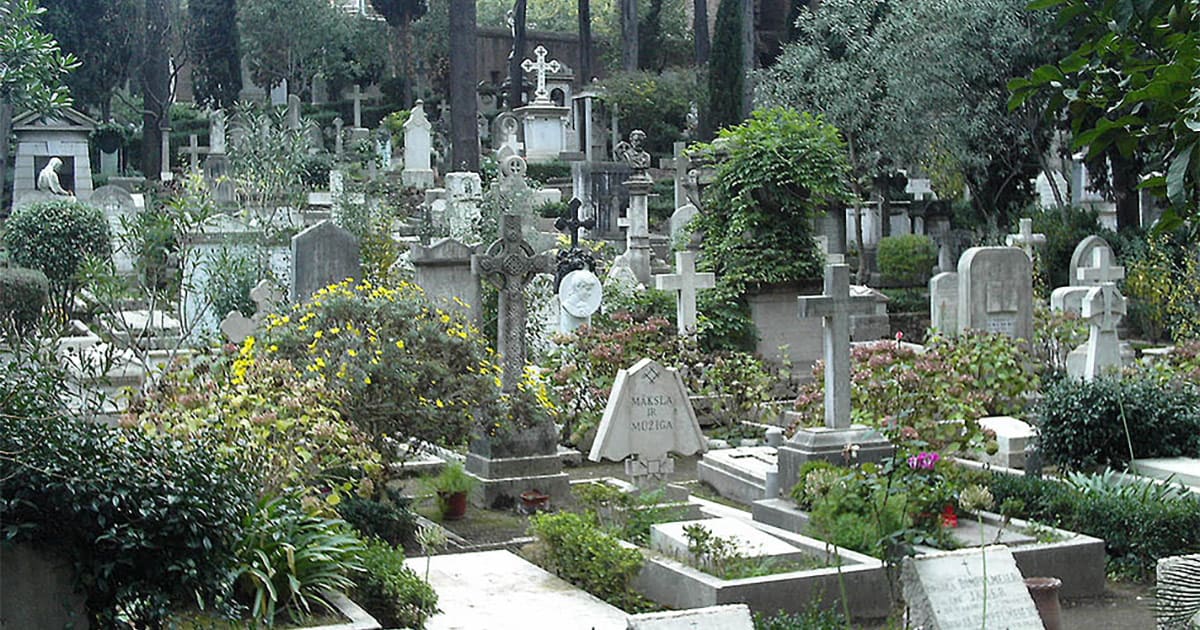
Visitors are greeted by a peaceful blend of green meadows, flowering shrubs, and solemn stone markers. Unlike many Catholic cemeteries, there are no photographs on the tombstones. Instead, the graves are adorned with poetic inscriptions in multiple languages, reflecting the diversity of those buried here.
Cats, undisturbed by visitors, wander gracefully among the graves, while the scent of pomegranate blossoms and Mediterranean cypresses drifts through the air. The white marble of the Pyramid of Cestius gleams in the background, giving the entire site a timeless quality.
A Cultural and Historical Landmark
The Protestant Cemetery is more than a burial ground—it is a testament to Rome’s multicultural heritage and its role as a crossroads of faith, art, and ideology. For centuries, it has been a sanctuary for those considered “foreign” in their own countries, whether due to religion, politics, or creative expression.
Today, it remains an active cemetery, though new burials are rare. Its care is entrusted to an international committee, reflecting its continued global significance.
Why Visit with a Golf Cart Tour?
Reaching the Protestant Cemetery on foot can be tiring, especially in the Roman heat. A golf cart tour ensures a comfortable, efficient journey from other city landmarks, allowing you to combine this visit with nearby attractions like the Pyramid of Cestius, Porta San Paolo, and the Testaccio neighborhood.
Your guide can provide historical context, read excerpts from Keats and Shelley’s works, and share personal anecdotes about the lives of those buried here. The experience is tailored to your interests—whether you’re drawn to literature, history, architecture, or simply the serene atmosphere.
Nearby Attractions
- Pyramid of Cestius – An ancient Roman pyramid built as a tomb, perfectly preserved within the Aurelian Walls.
- Porta San Paolo – One of Rome’s best-preserved ancient gates, offering insight into the city’s military history.
- Testaccio Market – A lively local market where you can sample Roman street food after your tour.
Planning Your Visit
The Protestant Cemetery is open year-round, but spring and autumn offer the most pleasant weather for exploration. Dress respectfully and be mindful that this is an active burial site. Photography is generally allowed, but always be discreet and respectful.
Book Your Protestant Cemetery Tour
A visit to the Protestant Cemetery is an unforgettable experience—one that blends poetry, history, and peace in a single location. Discover it the easy way with a golf cart tour, and let a private guide bring its stories to life.
Book your Protestant Cemetery tour today and step into a world where history rests beneath cypress shade, and the words of poets still echo among the stones.