Introduction
Standing between the Colosseum and the Palatine Hill, the Arch of Constantine is one of Rome’s most impressive ancient monuments. Erected in the early 4th century CE, it commemorates Emperor Constantine’s decisive victory and marks a moment of profound transformation in Roman history. Today it remains a must-see landmark for anyone exploring the archaeological heart of the Eternal City.
A Monument to Victory
The Arch of Constantine was inaugurated in 315 AD to celebrate Constantine’s triumph over Maxentius at the Battle of the Milvian Bridge (312 AD). Its location on the Via Triumphalis, the ancient route used for imperial processions, emphasizes its political significance: it symbolically welcomed Constantine into Rome as the legitimate and victorious ruler.
It is also the largest surviving triumphal arch in Rome, underlining the importance of Constantine’s victory and the turning point it represented for the Empire.
Architecture and Structure
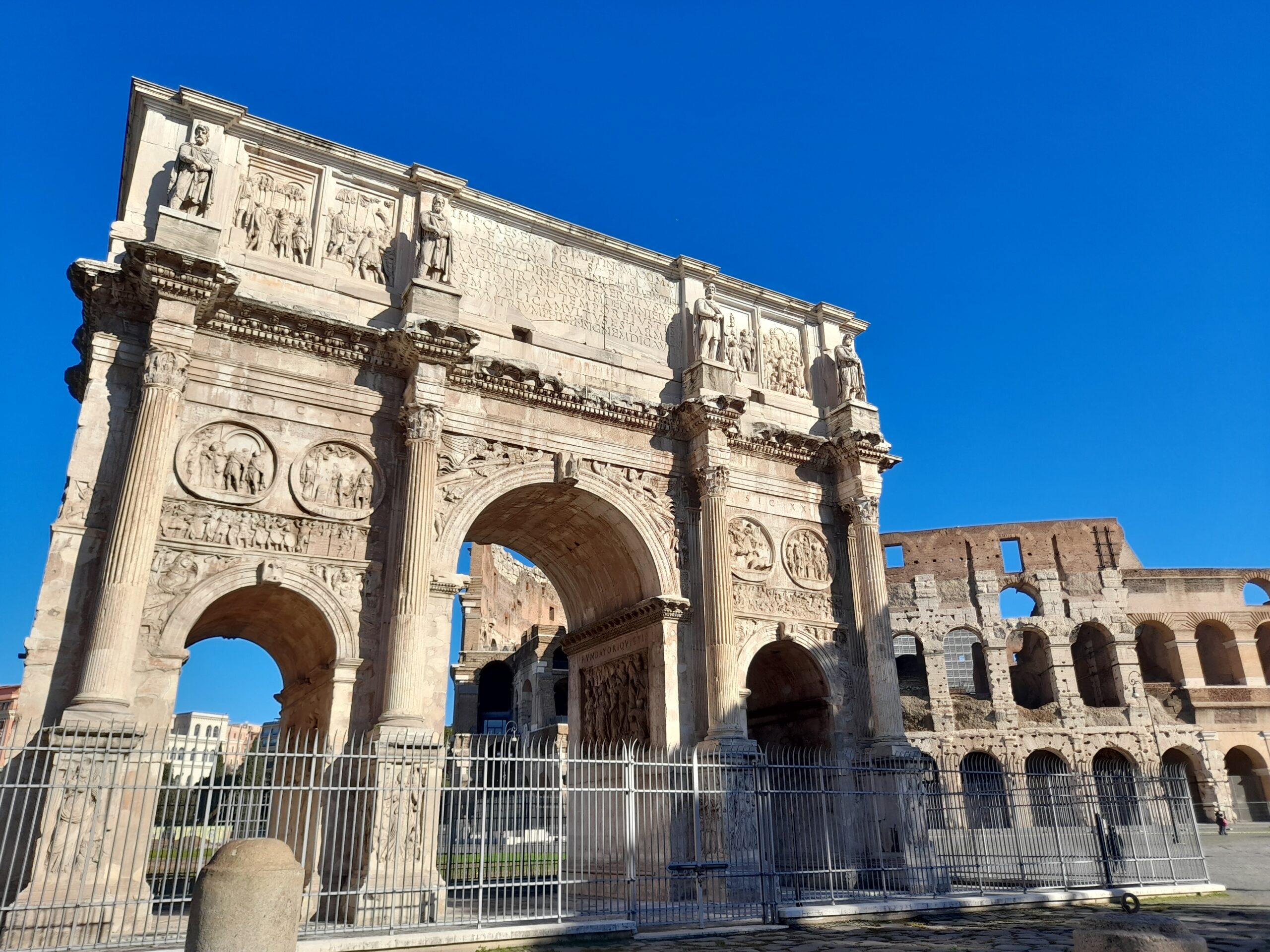
The Arch rises to an impressive height of about 21 meters, spans 26 meters in width, and measures 7.4 meters in depth. Its design features:
- Three arches: one monumental central passage and two smaller flanking arches
- Brick-faced concrete covered in marble
- A rich sculptural program including reliefs, medallions, inscriptions, and statues
One of the most distinctive elements of the monument is its use of spolia—sculptural pieces and decorative elements taken from earlier imperial monuments from the reigns of Trajan, Hadrian, and Marcus Aurelius. These pieces were adapted and re-carved to represent Constantine, linking him symbolically to the achievements and virtues of Rome’s greatest emperors.
The upper level (attic) displays a long Latin inscription honoring Constantine, flanked by statues of captured Dacians originally taken from Trajan’s Forum. Circular medallions above the side arches depict scenes of hunting and sacrifice, demonstrating the blending of past artistic traditions with Constantine’s political message.
A Shift in Roman Art
The Arch of Constantine is considered a landmark in the evolution of Roman art. It illustrates the transition from the classical, harmonious style of the High Empire to the more symbolic, abstract style of the Late Imperial period. Its combination of reused classical sculptures and newly carved reliefs reveals a changing artistic language and a shifting ideological landscape.
The Meta Sudans: A Lost Monument Nearby
In front of the arch once stood the Meta Sudans, a monumental fountain built during the Flavian dynasty. Although demolished in the 20th century, its foundations help reconstruct the ancient topography surrounding the Colosseum and highlight the ceremonial character of this area.
This part of Rome served as a stage for public rituals, triumphal entries, and imperial celebrations — making the Arch of Constantine a key feature in a much larger monumental landscape.
Why the Arch of Constantine Matters Today
The Arch is more than a commemorative gateway: it is a symbol of continuity, legitimacy, and transformation. It reflects the merging of different artistic eras, the propaganda strategies of a new ruler, and the evolving identity of the Roman Empire.
For today’s visitors, it offers:
- A unique visual connection to the Colosseum and the Palatine Hill
- Insight into imperial power and messaging
- A rare opportunity to walk along Rome’s ancient triumphal path
Visiting the Arch of Constantine
The Arch stands in a fully accessible, open-air area between the Colosseum and the Palatine Hill. It can be admired at any time and is an essential stop for anyone exploring Rome’s archaeological district.
To understand its symbolism, its reused artworks, and its place along the ancient ceremonial route, experiencing it with an expert guide makes all the difference.
Explore the Colosseum — and the Arch of Constantine — with Kirba Tours
Looking for the most complete way to discover ancient Rome?
Our Colosseum tours naturally include a close-up visit to the Arch of Constantine, revealing how these monuments worked together within Rome’s imperial landscape.
👉 Join a Colosseum Tour with Kirba Tours and experience the Arch of Constantine as part of Rome’s legendary triumphal route.